




Quality M-Sand for House Construction Mysore

Quality M-Sand for House Construction Mysore – Affordable M-Sand
Building a house in Mysore starts with choosing the right construction materials. Among the many materials required from foundation to finishing, sand plays an important role in concrete, masonry, plastering and several other construction activities.
If you are looking for Quality M-Sand for House Construction Mysore, it is important to understand that M-Sand is not simply a replacement for natural river sand. Different construction activities can require different grades and types of manufactured sand, and choosing the appropriate material can make a significant difference to the quality and workability of the construction.
We supply a wide range of construction materials in Mysore, including different types of M-Sand and other materials required for residential, commercial and infrastructure projects. Whether you are constructing an independent house, villa, apartment, commercial building or renovation project, our goal is to make sourcing construction materials easier by supplying materials from foundation to finish.
In this guide, we explain the different types of M-Sand available for construction, where each type can be used, what you should check before buying and how to choose the right M-Sand for your house construction in Mysore.
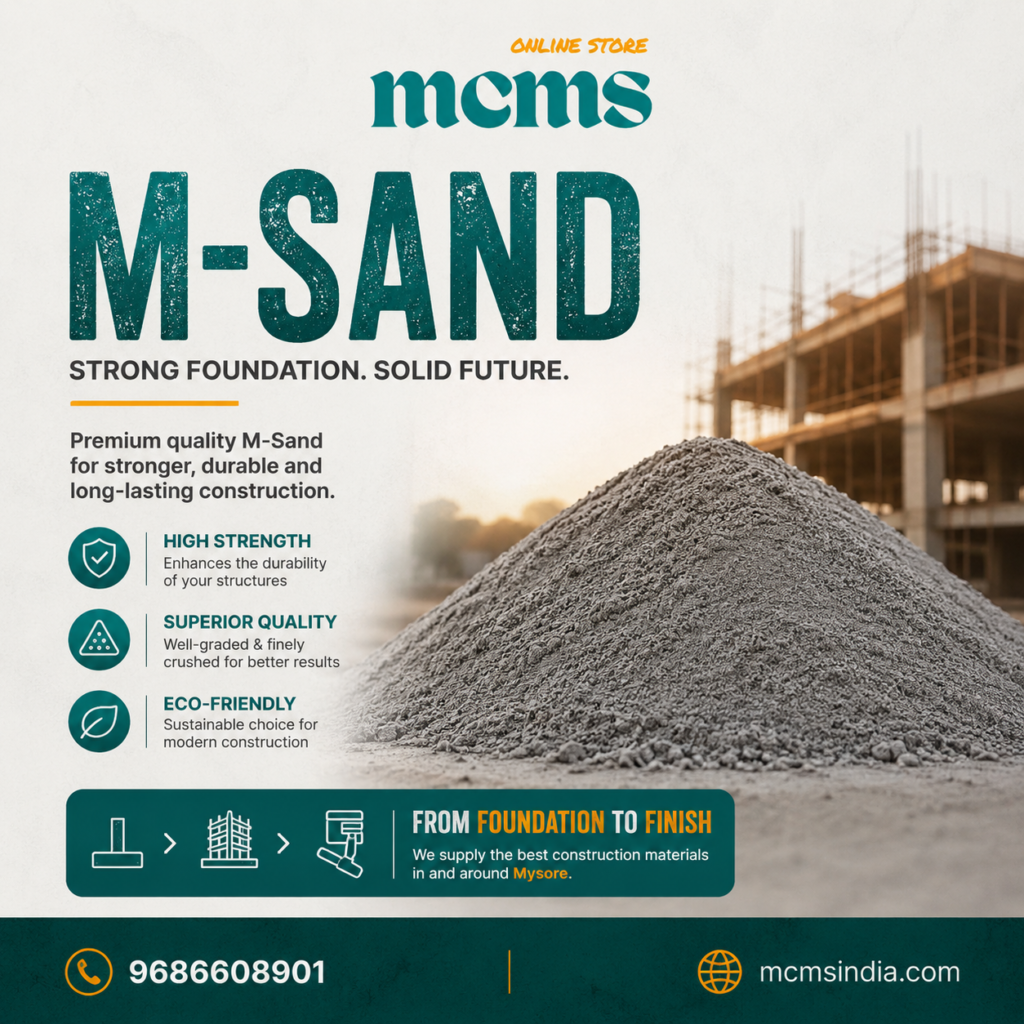
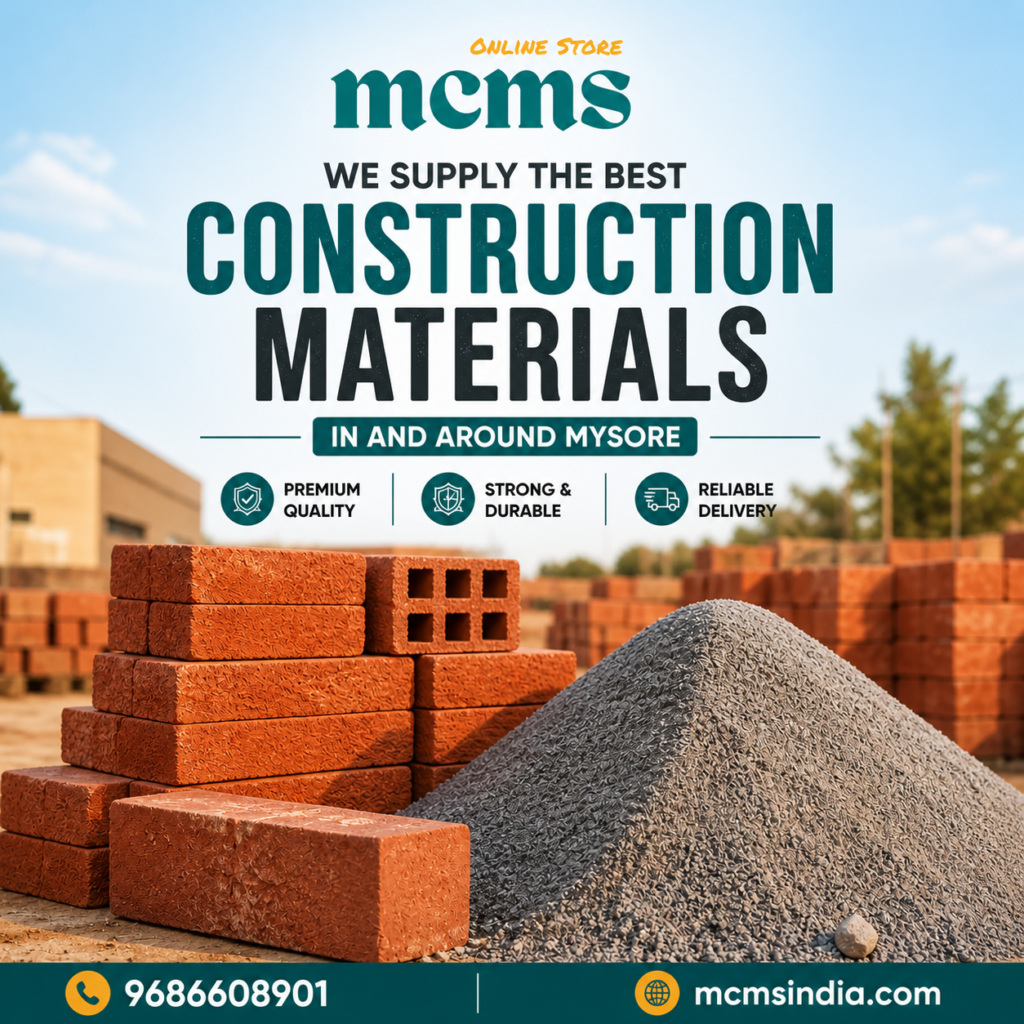
Table of Contents
- What Is M-Sand?
- Why Is M-Sand Important in House Construction?
- Quality M-Sand for House Construction Mysore
- Types of M-Sand We Supply in Mysore
- Concrete M-Sand
- Plastering M-Sand
- M-Sand for Masonry Work
- M-Sand for RCC Construction
- M-Sand for Block Work
- M-Sand for Flooring and Other Applications
- How to Identify Quality M-Sand
- M-Sand Grading and Particle Size
- Why Choose M-Sand Instead of Uncontrolled Sand
- How Much M-Sand Does a House Need?
- Factors That Affect M-Sand Requirements
- Buying M-Sand in Mysore
- Why Buy Construction Materials From One Supplier?
- Common Mistakes When Buying M-Sand
- M-Sand for Different Stages of House Construction
- Frequently Asked Questions
- Conclusion
What Is M-Sand?
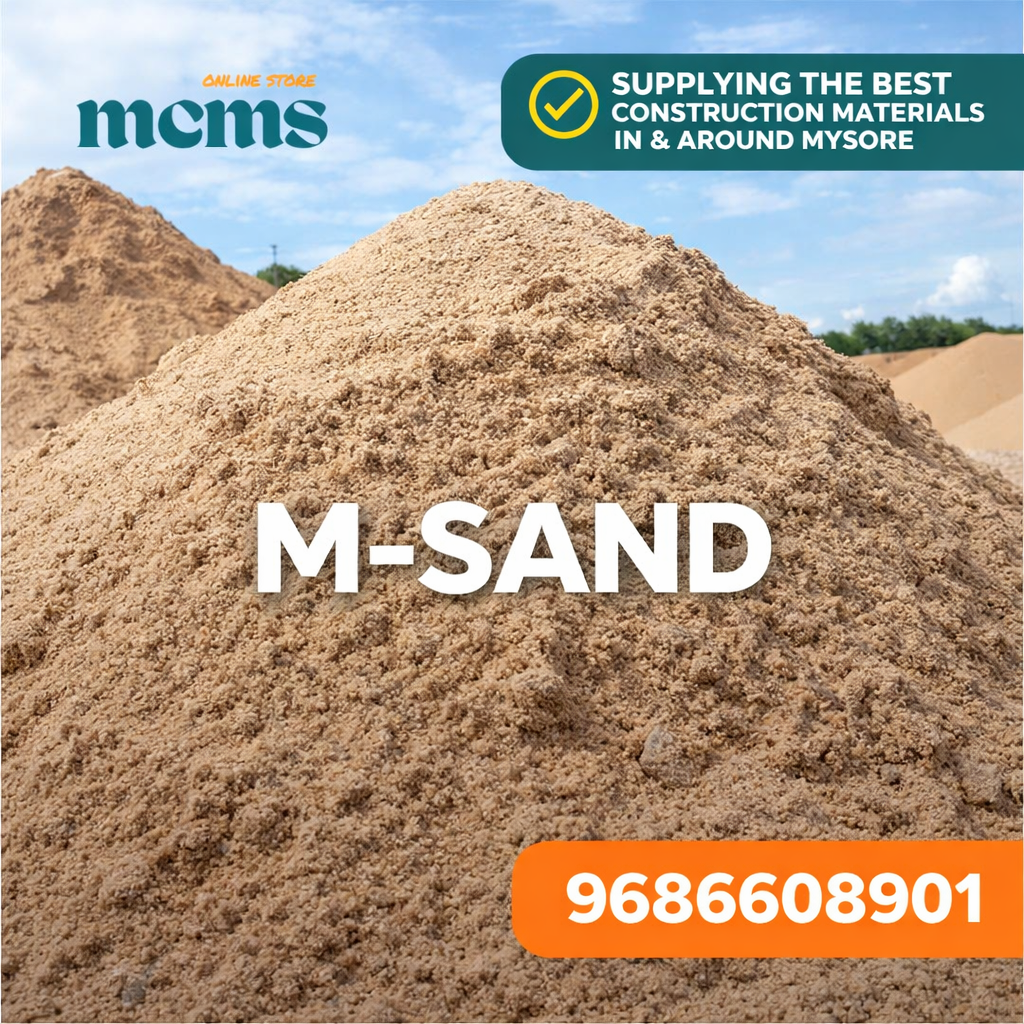
M-Sand, or manufactured sand, is a processed fine aggregate produced by crushing and processing suitable rock or stone materials to obtain particles used in construction.
Unlike naturally occurring river sand, manufactured sand is produced through a controlled process. The resulting material can be processed and graded for specific construction applications.
The Bureau of Indian Standards recognises manufactured fine aggregate as one of the categories of fine aggregate covered under IS 383:2016. The standard also distinguishes between natural sand, crushed sand, mixed sand and manufactured fine aggregate.
This is one reason why simply asking for “sand” may not always be enough when purchasing construction materials.
The right question is:
What type of sand is suitable for the particular construction work?
Concrete, masonry and plastering can have different requirements. A good construction-material supplier should therefore help customers select the appropriate material rather than treating every type of M-Sand as the same.

Why Is M-Sand Important in House Construction?
Sand is used in several stages of house construction.
It can be part of concrete mixes, mortar, plastering mixes and other applications. Because sand occupies a substantial portion of many construction mixes, its particle size, cleanliness, grading and other characteristics can influence workability and the performance of the finished material.
For concrete applications, IS 383:2016 provides requirements relating to aggregates, including grading and various quality characteristics.
This means that selecting construction sand should not be based only on the lowest price.
A contractor, engineer or homeowner should consider:
- Intended application
- Particle size and grading
- Cleanliness
- Presence of unwanted materials
- Moisture condition
- Consistency of supply
- Compatibility with the specified mix
- Quality testing where required
Quality M-Sand for House Construction Mysore
When you search for Quality M-Sand for House Construction Mysore, the most important thing is to choose a supplier who understands the difference between construction applications.
For a house project, you may require M-Sand for RCC work, masonry, plastering or other applications.
The exact material required should be selected according to the project specifications and advice from your structural engineer, architect or site engineer.
A reliable supplier should also be able to discuss:
- Which M-Sand is being supplied
- Where it is recommended for use
- Available quantity
- Delivery location
- Material consistency
- Testing or quality documentation where applicable
- Whether the same material is suitable for your intended application
Our construction-material supply service in Mysore is designed around this complete-project requirement.
Instead of sourcing every material from different suppliers, customers can enquire about the construction materials required for their project from foundation to finishing.
Types of M-Sand We Supply in Mysore
Different construction activities can require different characteristics from fine aggregate.
Depending on project requirements and availability, we supply different types and grades of M-Sand suitable for various construction applications.
1. Concrete M-Sand
Concrete M-Sand is used as fine aggregate in concrete-related applications where the material meets the required specifications.
It may be considered for concrete work used in:
- Foundations
- Footings
- Columns
- Beams
- Slabs
- RCC structures
- Concrete floors
- Other structural and non-structural concrete applications
For structural concrete, the material should be selected according to the project specification and applicable standards.
IS 383:2016 covers coarse and fine aggregates for concrete and includes requirements relating to properties such as grading and mechanical characteristics.
The correct concrete mix should also be determined by the responsible engineer or mix-design professional rather than simply changing sand quantities based on guesswork.
2. Plastering M-Sand
Plastering requires a fine aggregate that provides suitable workability and finish for the intended plaster application.
Plastering M-Sand can be used for suitable internal and external plastering work when it meets the project’s requirements.
It can be used in areas such as:
- Internal wall plaster
- External wall plaster
- Ceiling plaster
- Repair and finishing work
- Selected masonry finishing applications
The grading and characteristics of the sand matter because plaster needs to be workable and capable of producing an acceptable surface finish.
If your site engineer has specified a particular plastering sand or grading, that specification should be followed.
3. M-Sand for Masonry Work
Masonry work involves laying bricks, blocks or other masonry units using mortar.
M-Sand can be used in suitable masonry mortar applications when the material is appropriate for the intended purpose.
Good mortar should have suitable workability and bond characteristics for the masonry system being used.
For this reason, customers should not automatically use the same sand for every activity on a construction site.
4. M-Sand for Block Work
Modern house construction commonly uses concrete blocks, AAC blocks and other masonry systems.
The mortar or adhesive system used with these products depends on the particular block and construction method.
Where M-Sand is specified for mortar or related work, the appropriate grade should be selected based on the construction system.
For AAC block construction in particular, follow the block manufacturer’s and project engineer’s recommendations because thin-bed adhesive systems are commonly used instead of conventional thick mortar.
5. M-Sand for RCC Construction
RCC construction requires careful control of the concrete ingredients.
M-Sand used in RCC concrete should satisfy the requirements specified for the project.
RCC applications can include:
- Footings
- Columns
- Beams
- Roof slabs
- Staircases
- Retaining structures
- Other reinforced concrete components
The sand should never be selected purely because it looks fine or because another project used the same material.
The concrete mix design and applicable specifications should determine the appropriate aggregate.
6. M-Sand for Flooring and General Construction
Certain flooring, bedding, mortar and general construction activities can also use suitable manufactured sand.
However, the appropriate material depends on the specific work.
For example, sand used underneath a particular flooring system may have different requirements from fine aggregate used in structural concrete.
This is why discussing the application with your contractor or supplier before ordering can prevent unnecessary material changes later.
How to Identify Quality M-Sand
A common mistake is to judge sand quality only by its colour.
Colour alone is not a reliable way to determine whether a particular M-Sand is appropriate for construction.
Instead, consider several characteristics.
Check the Grading
Particle-size distribution is important.
A properly graded fine aggregate can contribute to suitable packing and workability in a mix.
IS 383 includes requirements for the size and grading of aggregates, including fine aggregate.
Check for Excessive Unwanted Material
Excessive clay lumps, organic impurities or other deleterious materials can affect the suitability of aggregate.
BIS materials identify various tests and requirements concerning unwanted materials and other characteristics of aggregates.
Check Consistency
For a large house project, consistency from one delivery to another is important.
If the material characteristics change significantly during construction, it can affect mixing and application.
Ask About Testing
For larger or technically demanding projects, testing may be appropriate.
Depending on the application, aggregate testing can include grading, specific gravity, water absorption and other relevant properties.
BIS testing information for IS 383 includes parameters such as fine-aggregate grading, specific gravity, water absorption and material finer than 75 microns.
M-Sand Grading and Particle Size
One of the most important concepts in manufactured sand is grading.
Fine aggregate is not simply classified as “good” or “bad” based on how fine it looks.
The particle-size distribution needs to be suitable for the intended application.
For concrete, IS 383:2016 provides grading requirements for fine aggregate. The standard also identifies different grading zones for fine aggregates.
This is particularly important for contractors and engineers because the correct grading can influence:
- Workability
- Packing of particles
- Water demand
- Mix behaviour
- Surface finish
- Overall performance
Therefore, when ordering M-Sand for a house, tell the supplier what the material will be used for.
Why Choose M-Sand Instead of Uncontrolled Sand?
Manufactured sand provides an engineered alternative to relying on naturally occurring sand.
Because it is produced through crushing and processing, manufacturers can control aspects of the production process and grading.
However, this does not mean that every M-Sand product is automatically suitable for every construction activity.
The quality of the source material, crushing process, screening, washing, grading and quality control all matter.
The correct approach is to purchase M-Sand suitable for the intended application and project specification.
How Much M-Sand Does a House Need?
There is no single M-Sand quantity that applies to every house.
The amount required depends on the design and construction method.
For example, a 1,200-square-foot house and a 2,500-square-foot house will not necessarily have a simple proportional relationship in material requirements.
Quantities can be affected by:
- Built-up area
- Number of floors
- Foundation design
- RCC quantity
- Wall construction
- Plastering area
- Flooring system
- Mortar requirements
- Concrete mix design
- Wastage
- Site conditions
The best way to calculate the requirement is to prepare a detailed material estimate based on the structural and architectural drawings.
Your contractor or engineer can prepare the quantity estimate, after which a supplier can arrange deliveries according to the construction schedule.
Factors That Affect M-Sand Requirements
When estimating M-Sand for a house, several factors should be considered.
House Size
A larger built-up area generally requires more construction materials, but the exact requirement depends on the design.
Number of Floors
A multi-storey building may require substantially different quantities of concrete and masonry materials compared with a single-storey house.
Structural Design
Foundation dimensions, column sizes, beam sizes and slab thickness all affect concrete quantities.
Wall Material
Brick walls, concrete blocks and AAC blocks have different material requirements.
Plastering
The total plastering area and plaster thickness influence the quantity of sand required.
Construction Method
Traditional masonry and newer construction systems can have significantly different mortar requirements.
Buying M-Sand in Mysore
When purchasing M-Sand in Mysore, delivery is another important consideration.
Construction sites need materials at the right time.
A delay in sand delivery can affect masonry, concrete, plastering or other site activities.
Before ordering, confirm:
- Required quantity
- Type of M-Sand
- Intended application
- Delivery location
- Required delivery date
- Site access
- Unloading arrangements
- Payment terms
- Any project-specific quality requirements
This becomes especially important during the busy stages of construction when several materials are being consumed simultaneously.
Why Buy Construction Materials From One Supplier?
Building a house involves much more than buying sand.
You may need materials for:
Foundation: cement, aggregates, steel, sand and other foundation materials.
Structure: cement, steel, aggregates, M-Sand and related materials.
Masonry: bricks or blocks, mortar materials and related products.
Plastering: cement, suitable sand and finishing materials.
Flooring: tiles, stone, adhesives, grout and related materials.
Finishing: plumbing materials, electrical products, sanitaryware, paints and other finishing requirements.
Working with a construction-material supplier who can provide materials from foundation to finish can make procurement easier.
Instead of contacting many suppliers for every small requirement, homeowners and contractors can consolidate their purchases where practical.
You can also internally link this article to your relevant service pages, for example:
- [Construction Materials Supplier in Mysore]
- [Cement Suppliers in Mysore]
- [TMT Steel Suppliers in Mysore]
- [M-Sand Suppliers in Mysore]
- [Building Materials Suppliers in Mysore]
- [Aggregates Suppliers in Mysore]
- [Bricks and Blocks Suppliers in Mysore]
Replace each placeholder above with the URL of the corresponding page on your website.
Common Mistakes When Buying M-Sand
Mistake 1: Buying Only Based on Price
The cheapest material is not necessarily the most economical option.
If unsuitable sand creates problems with workability, finishing or mix performance, the apparent saving can disappear quickly.
Mistake 2: Using One Type for Everything
Concrete, plastering and masonry can have different requirements.
Always check what your engineer or contractor has specified.
Mistake 3: Ignoring Grading
Fine aggregate grading is an important consideration.
A material that looks visually acceptable may still require testing to determine whether it meets the relevant requirements.
Mistake 4: Ordering Too Much at Once
Storage conditions matter.
Ordering excessive quantities can create unnecessary storage problems and may interfere with site movement.
Mistake 5: Not Planning Delivery
Construction sites operate according to schedules.
Coordinate material delivery with the contractor so that the material arrives when it is required.
M-Sand for Different Stages of House Construction
A typical house project progresses through several stages.
Stage 1: Foundation
The foundation may involve PCC, RCC and other works depending on the structural design.
Appropriate aggregates and fine aggregate are selected according to the concrete specification.
Stage 2: RCC Structure
Columns, beams and slabs require carefully proportioned concrete.
The M-Sand used for these applications should be suitable for concrete and comply with the project requirements.
Stage 3: Masonry
Once the structural work progresses, brick or block masonry begins.
The appropriate mortar material should be selected for the masonry system.
Stage 4: Plastering
Plastering requires attention to sand grading, mix proportions, thickness and workmanship.
Using the right material can make the application easier and contribute to the desired surface finish.
Stage 5: Finishing
Later stages may involve flooring, painting, electrical, plumbing, doors, windows and other finishing materials.
A complete construction-material supplier can help coordinate procurement throughout these stages.
Quality M-Sand for House Construction Mysore: What Should You Ask Your Supplier?
Before placing your order, ask a few simple questions.
What is this M-Sand intended for?
Tell the supplier whether it is for concrete, plastering, masonry or another application.
What quantity do I need?
Give the supplier your estimated requirement and delivery schedule.
Is the material suitable for my project specification?
For structural applications, confirm with your engineer.
Can you supply consistently?
Large projects may require multiple deliveries, so consistency matters.
Can you deliver to my construction site in Mysore?
Confirm the delivery area and site access before placing the order.
A professional supplier should be willing to discuss these points instead of simply quoting a price.
Why Choose Us for Construction Materials in Mysore?
We supply construction materials for projects in Mysore with a focus on making material procurement simple and convenient.
Our supply range is not limited to one construction product.
We can help customers source materials required across different stages of construction, from foundation work through structural construction, masonry, plastering and finishing.
For customers looking specifically for Quality M-Sand for House Construction Mysore, we can help identify the appropriate type of M-Sand based on the intended application and project requirement.
Our goal is simple:
The right construction material, supplied when your project needs it.
Whether you are a homeowner building your first house, a contractor managing multiple projects, a builder developing residential properties or a civil engineer coordinating materials, you can contact us to discuss your construction-material requirements.
Frequently Asked Questions About M-Sand in Mysore
Is M-Sand suitable for house construction?
Yes, suitable manufactured sand can be used in various house-construction applications, depending on its properties and the intended use. For concrete applications, the aggregate should meet the applicable project and standard requirements.
Is M-Sand the same as river sand?
No. M-Sand is manufactured through processing, while river sand is naturally occurring sand. BIS classifies natural sand and manufactured fine aggregate as distinct categories of fine aggregate.
Can the same M-Sand be used for concrete and plastering?
Not necessarily.
Different applications can have different requirements. Always check the specifications recommended by your engineer, contractor or material supplier.
Which M-Sand is best for RCC?
The appropriate fine aggregate for RCC should be selected according to the concrete mix design and project specifications. Your structural engineer or concrete professional should determine the appropriate material.
Which M-Sand is suitable for plastering?
A suitable plastering M-Sand should have characteristics appropriate for the plaster application, including suitable grading and cleanliness. The required material can vary depending on the plastering system.
How do I know whether M-Sand is good quality?
Do not rely only on appearance.
Consider grading, cleanliness, consistency and relevant test results. For technical projects, testing according to applicable standards can provide more reliable information.
Can I buy M-Sand in bulk in Mysore?
Yes. Bulk supply can be arranged depending on quantity, location and availability.
It is best to provide the required quantity and construction-site location when requesting a quotation.
Do you supply other construction materials?
Yes. We supply a broad range of construction materials required for house construction and other building projects, from foundation materials through finishing materials.
Contact us with your complete material requirement so that we can help you plan your purchases.
Final Thoughts
Choosing the right sand is a small decision that can have a significant role in a construction project.
If you are building a house in Mysore, do not simply ask for the cheapest sand available. First determine what the material is going to be used for and then select the appropriate M-Sand according to the project requirements.
Whether you need M-Sand for concrete, RCC work, masonry, plastering or another construction application, choosing a dependable supplier can make material procurement much easier.
If you are searching for Quality M-Sand for House Construction Mysore, get in touch with us and tell us about your project, required quantity and application.
We can help you source M-Sand along with other construction materials required from foundation to finish.
Building a house in Mysore? Talk to us about your complete construction-material requirement today.
We will never break your trust like others do