




High Quality Aggregates for Building Construction

High Quality Aggregates for Building Construction in Mysore
High Quality Aggregates for Building Construction are an essential part of almost every construction project. From house foundations and RCC structures to roads, flooring, drainage work and landscaping, the right aggregate helps create a strong and durable base for construction.
If you are looking for high quality aggregates in Mysore for your residential, commercial or infrastructure project, choosing the correct type, size and quality of aggregate is important. Poor-quality or incorrectly graded materials can affect concrete performance, increase material consumption and create unnecessary construction problems.
We supply a wide range of construction materials in Mysore, including different types and sizes of aggregates required from the foundation stage to the finishing stage of construction.
Whether you are constructing an independent house, apartment, commercial building, warehouse, industrial structure, compound wall or other civil work, we can help you source the required construction materials in the appropriate quantity and specification.
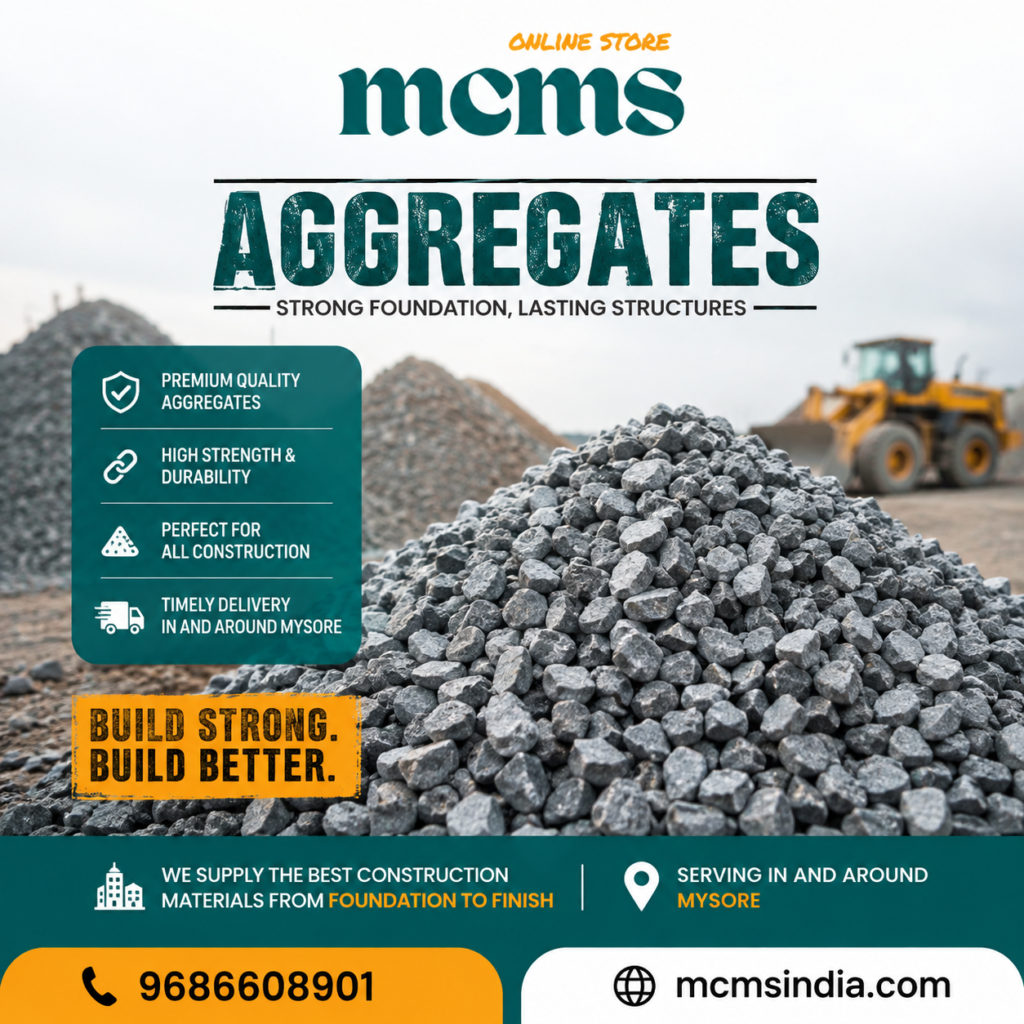
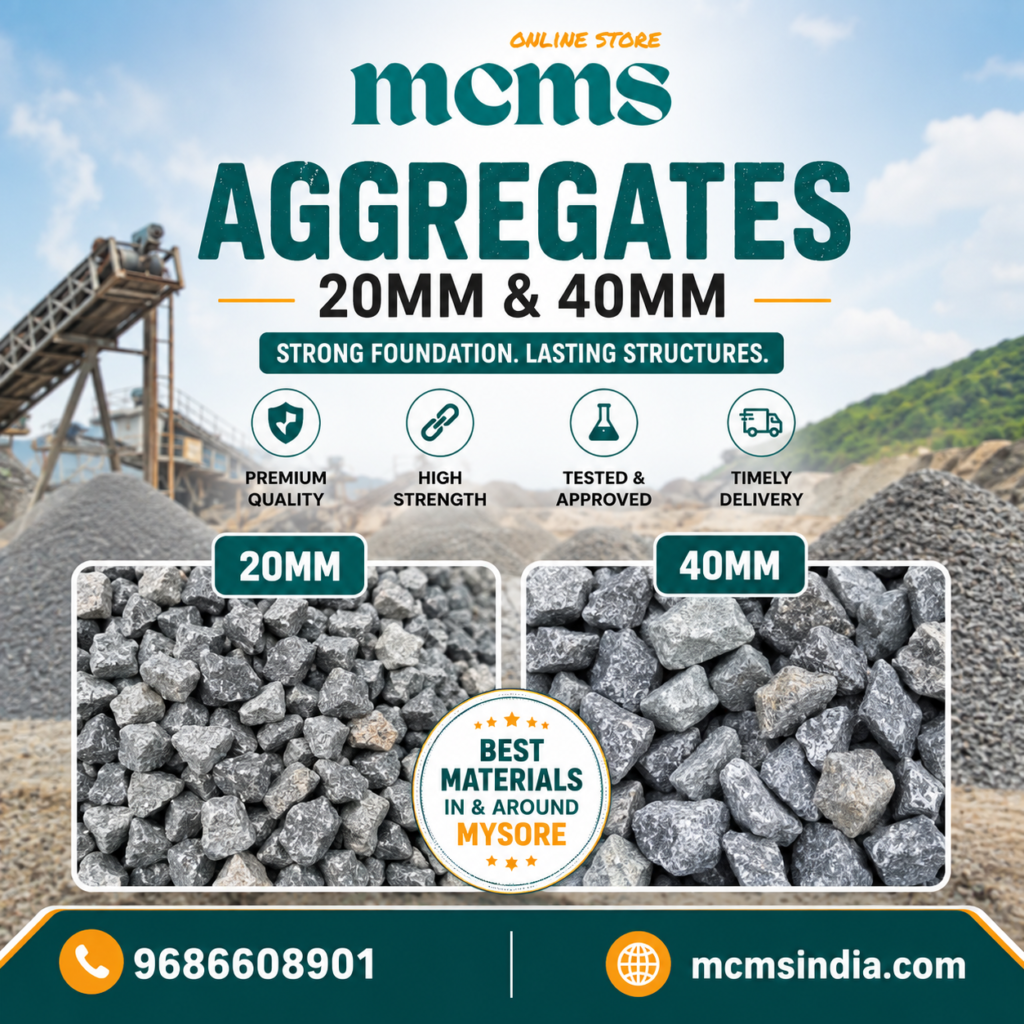
Table of Contents
- What Are Aggregates in Construction?
- Why High Quality Aggregates Are Important
- Types of Aggregates We Supply in Mysore
- 6 mm Aggregates
- 10 mm Aggregates
- 12 mm and 12.5 mm Aggregates
- 20 mm Aggregates
- 40 mm Aggregates
- 40 mm and Larger Aggregates for Specific Applications
- Jelly Stone Aggregates
- Crushed Stone Aggregates
- Aggregate Dust and Stone Dust
- Manufactured Sand and Fine Aggregates
- Aggregates for RCC Construction
- Aggregates for Foundation Work
- Aggregates for Road and Driveway Construction
- Aggregates for Paver and Flooring Work
- How to Choose the Right Aggregate
- Quality Factors to Check Before Buying Aggregates
- Why Buy Aggregates From a Reliable Supplier?
- Construction Materials From Foundation to Finish
- Aggregates Supply Across Mysore
- Frequently Asked Questions
- Conclusion
What Are Aggregates in Construction?
Aggregates are granular construction materials that are mixed with cement, water and other materials to produce concrete and mortar. They are also used independently for foundations, road bases, filling, drainage, paving and several other construction applications.
Aggregates can generally be divided into fine aggregates and coarse aggregates.
Fine aggregates include materials such as manufactured sand and other suitable fine materials. Coarse aggregates are larger particles such as crushed stone and jelly used in concrete and other civil works.
According to IS 383:2016, aggregates for concrete include both coarse and fine aggregates, with requirements relating to grading, mechanical properties, soundness and other characteristics.
The size of aggregate required depends on the construction application, concrete mix, structural requirements and recommendations of the engineer or contractor.
Why High Quality Aggregates Are Important
Choosing High Quality Aggregates for Building Construction is not simply about purchasing stones at the lowest price.
The aggregate forms a significant portion of concrete. Its size, shape, grading, cleanliness, strength and other characteristics can influence the performance of the finished concrete.
Good-quality aggregates can help with:
- Proper concrete workability
- Better packing of particles
- Efficient use of cement
- Good strength development
- Reduced unwanted voids
- Better durability
- Consistent construction quality
- Suitable performance for the intended application
BIS identifies properties such as aggregate crushing value, impact value, abrasion value, soundness and grading as relevant characteristics for aggregates used in concrete.
This is why it is important to select aggregates according to the specific project rather than simply choosing one size for every application.
Types of High Quality Aggregates for Building Construction We Supply
We supply different types and sizes of aggregates for construction projects in and around Mysore.
The exact aggregate required depends on the work being carried out. Some common materials include:
- 6 mm aggregates
- 10 mm aggregates
- 12 mm/12.5 mm aggregates
- 20 mm aggregates
- 40 mm aggregates
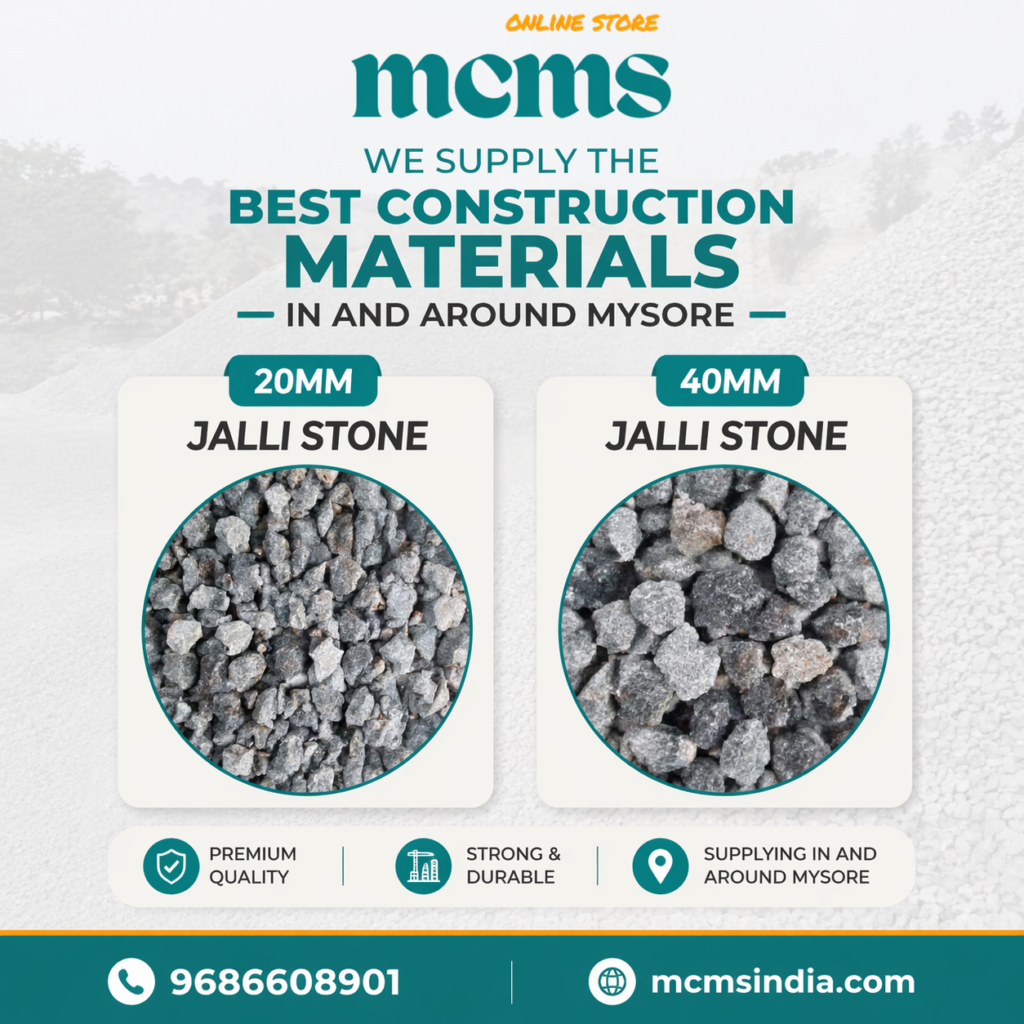
- Jelly stone
- Crushed stone aggregates
- Stone chips
- Aggregate dust
- Stone dust
- Fine aggregates
- Manufactured sand/M-Sand
- Road base aggregates
- Filling and leveling aggregates
- Aggregates for concrete and RCC work
Availability of a particular size or material may vary depending on project requirements and current supply.
6 mm Aggregates
6 mm aggregates are smaller-sized stone particles used for specific construction and finishing applications.
Depending on the project, smaller aggregates may be used in:
- Concrete-related applications
- Flooring work
- Paver-related work
- Small precast products
- Surface preparation
- Other civil construction applications
The exact suitability should be confirmed according to the project specification.
10 mm Aggregates
10 mm aggregate is a commonly used coarse aggregate size in construction.
It can be suitable for applications where a smaller coarse aggregate is preferred, depending on the concrete mix and structural requirements.
Typical applications can include:
- RCC work where specified
- Precast concrete products
- Smaller concrete sections
- Flooring and related civil work
- General construction applications
BIS’s grouping guidance for IS 383 includes 10 mm as one of the recognized single-size coarse aggregate sizes.
12 mm and 12.5 mm Aggregates
12 mm or 12.5 mm aggregates can be used for concrete and other construction applications where the specified grading calls for this size.
The correct aggregate size should always be selected based on the design mix, reinforcement arrangement, member dimensions and project requirements.
For structural construction, the engineer or project consultant should determine the appropriate aggregate size rather than selecting it solely based on availability.
20 mm Aggregates
20 mm aggregate is one of the most commonly requested coarse aggregates for general building construction.
It is frequently considered for concrete work such as:
- RCC slabs
- Beams
- Columns
- Footings
- Foundations
- Concrete floors
- General structural concrete
The suitability of 20 mm aggregate depends on the concrete design and structural requirements.
For many building projects, it is important to maintain consistent grading and avoid excessive dust, clay or other unwanted materials.
40 mm Aggregates
40 mm aggregate is a larger coarse aggregate used for applications where larger aggregate is appropriate.
Potential applications include:
- Mass concrete
- Road-related construction
- Large concrete works
- Foundations and other civil works where specified
- Filling and leveling applications
IS 383 recognizes 40 mm as one of the coarse aggregate sizes used for concrete.
Because aggregate size can affect concrete placement and compaction, the correct size should be selected according to the project specification.
40 mm and Larger Aggregates for Specific Applications
Large aggregates can be useful in particular civil engineering and mass concrete applications.
They are not automatically suitable for every building component. For example, densely reinforced RCC members may require a smaller aggregate size to allow proper placement and compaction.
Therefore, before ordering large quantities, discuss the requirement with your engineer, contractor or site supervisor.
We can help customers understand the available aggregate sizes and arrange material according to the project requirement.
Jelly Stone Aggregates for Construction
The term jelly is commonly used in the construction industry to describe crushed stone aggregates.
Different sizes of jelly are used for different construction applications.
Depending on the required size, jelly can be used for:
- Concrete production
- Foundation work
- Road construction
- Driveways
- Paver bases
- Drainage work
- Filling
- General civil construction
The correct size should be selected according to the intended application rather than assuming that every type of jelly is interchangeable.
Crushed Stone Aggregates
Crushed stone aggregates are produced by crushing suitable rock into different sizes.
They are widely used in building and civil construction because different particle sizes can be produced for different applications.
The advantages of properly selected crushed aggregates include:
- Availability in different sizes
- Suitable particle grading
- Good load-bearing characteristics for appropriate applications
- Versatility
- Suitability for concrete and civil works when meeting the relevant requirements
For concrete applications, aggregate quality and grading should be considered along with the cement, water and mix design.
Aggregate Dust and Stone Dust
Aggregate dust or stone dust consists of fine particles generated during the crushing and processing of stone.
Depending on its grading and quality, stone dust may be used for:
- Filling
- Leveling
- Paver bedding or related applications where specified
- Road work
- Landscaping
- Other civil works
However, stone dust should not automatically be substituted for fine aggregate in every concrete application.
For concrete and structural work, use the material specified by the project engineer and applicable standards.
Manufactured Sand and Fine Aggregates
Fine aggregate is another important component of construction.
Manufactured sand, commonly called M-Sand, is produced by processing crushed stone into a suitable fine aggregate.
It is widely used as an alternative source of fine aggregate for various construction applications.
Depending on the type and specification, fine aggregate can be used for:
- Concrete
- Masonry
- Plastering
- Flooring
- Block work
- General building construction
BIS recognizes natural sand, crushed sand, mixed sand and manufactured fine aggregate within its classification of fine aggregates.
For different applications, the required grading and quality can differ, so it is important to select the appropriate material rather than using one type of sand for every construction activity.
Aggregates for RCC Construction
RCC, or reinforced cement concrete, is widely used in modern building construction.
RCC elements may include:
- Footings
- Columns
- Beams
- Slabs
- Staircases
- Retaining structures
- Other reinforced concrete components
Aggregate selection is important because the particles need to work properly with cement paste and reinforcement.
For RCC work, the aggregate size should be selected based on factors such as:
- Member dimensions
- Reinforcement spacing
- Concrete grade
- Mix design
- Placement method
- Pumping requirements
- Engineer’s specification
Using the correct material consistently can make concrete batching and site work easier.
Aggregates for Foundation Work
The foundation is one of the most important stages of building construction.
Depending on the foundation design and construction method, aggregates may be required for:
- PCC
- RCC footings
- Foundation concrete
- Site leveling
- Filling
- Drainage
- Hardstanding
- Other foundation-related works
The aggregate required for a foundation depends on the structural design.
For this reason, homeowners should follow the material specification provided by their structural engineer or contractor.
Aggregates for Road and Driveway Construction
Aggregates are also widely used outside the building structure itself.
They can be required for:
- Internal roads
- Driveways
- Parking areas
- Farm roads
- Site access roads
- Pathways
- Road base layers
- Drainage-related construction
Different layers may require different aggregate sizes and grading.
A properly prepared aggregate base can provide a suitable foundation for the next construction layer, depending on the pavement design.
Aggregates for Paver and Flooring Work
Paver installation requires proper preparation of the underlying surface.
Aggregates and fine materials may be used for:
- Base preparation
- Leveling
- Bedding
- Filling
- Drainage layers
The exact material depends on the type of paver, ground condition, traffic loading and installation method.
For high-traffic areas, commercial properties and parking spaces, proper base preparation is particularly important.
How to Choose the Right Aggregate for Your Project
Not every aggregate is suitable for every construction application.
Before ordering, consider the following factors.
1. Identify the Construction Application
First determine where the material will be used.
Is it for:
- Foundation?
- RCC?
- Slab?
- Column?
- Beam?
- Road?
- Driveway?
- Paver?
- Filling?
- Drainage?
- Landscaping?
The answer helps determine the appropriate material.
2. Confirm the Required Size
Aggregate size matters.
A 20 mm aggregate, for example, should not automatically be replaced with 40 mm simply because both are coarse aggregates.
Check the construction specification before ordering.
3. Consider Grading
Proper grading means that the aggregate particles are distributed across the required size range.
Appropriate grading can influence packing, workability and the amount of cement paste needed.
4. Check Cleanliness
Construction aggregates should be suitable for their intended application and should not contain excessive unwanted materials such as clay, organic matter or other deleterious substances.
5. Buy the Required Quantity
Ordering too little can interrupt construction.
Ordering excessive material can create storage and handling problems.
It is therefore useful to estimate quantities before delivery.
6. Follow Your Engineer’s Specification
For structural work, the structural engineer’s specifications should take priority.
A material supplier can provide available material and help with supply, but the structural design determines what should be used in the structure.
Quality Factors to Check Before Buying Aggregates
When purchasing High Quality Aggregates for Building Construction, look beyond the price per load.
Important considerations include:
Aggregate Size
The aggregate should match the specified size or grading.
Shape and Texture
Particle shape and surface characteristics can affect how aggregates behave in concrete.
Strength
Aggregates need appropriate mechanical properties for their intended application.
Water Absorption
Aggregate water absorption can affect the water balance of a concrete mix.
Cleanliness
Excessive dust, clay or other unwanted materials can affect performance.
Grading
Proper grading is important for concrete and other applications.
Source and Consistency
Material from a reliable source can make it easier to maintain consistency between deliveries.
BIS’s IS 383 documentation identifies characteristics including grading, crushing value, impact value, abrasion, soundness and other requirements for aggregates used in concrete.
Why Buy Aggregates From a Reliable Supplier in Mysore?
Construction projects depend on timely material supply.
A delay in aggregates can affect concrete work, labor scheduling and overall project progress.
A reliable local supplier can help with:
- Material availability
- Different aggregate sizes
- Bulk requirements
- Delivery coordination
- Construction material planning
- Foundation-to-finish material supply
- Project-specific requirements
For builders and homeowners in Mysore, working with a supplier who understands local construction requirements can simplify material procurement.
Construction Materials From Foundation to Finish
We are not limited to supplying aggregates.
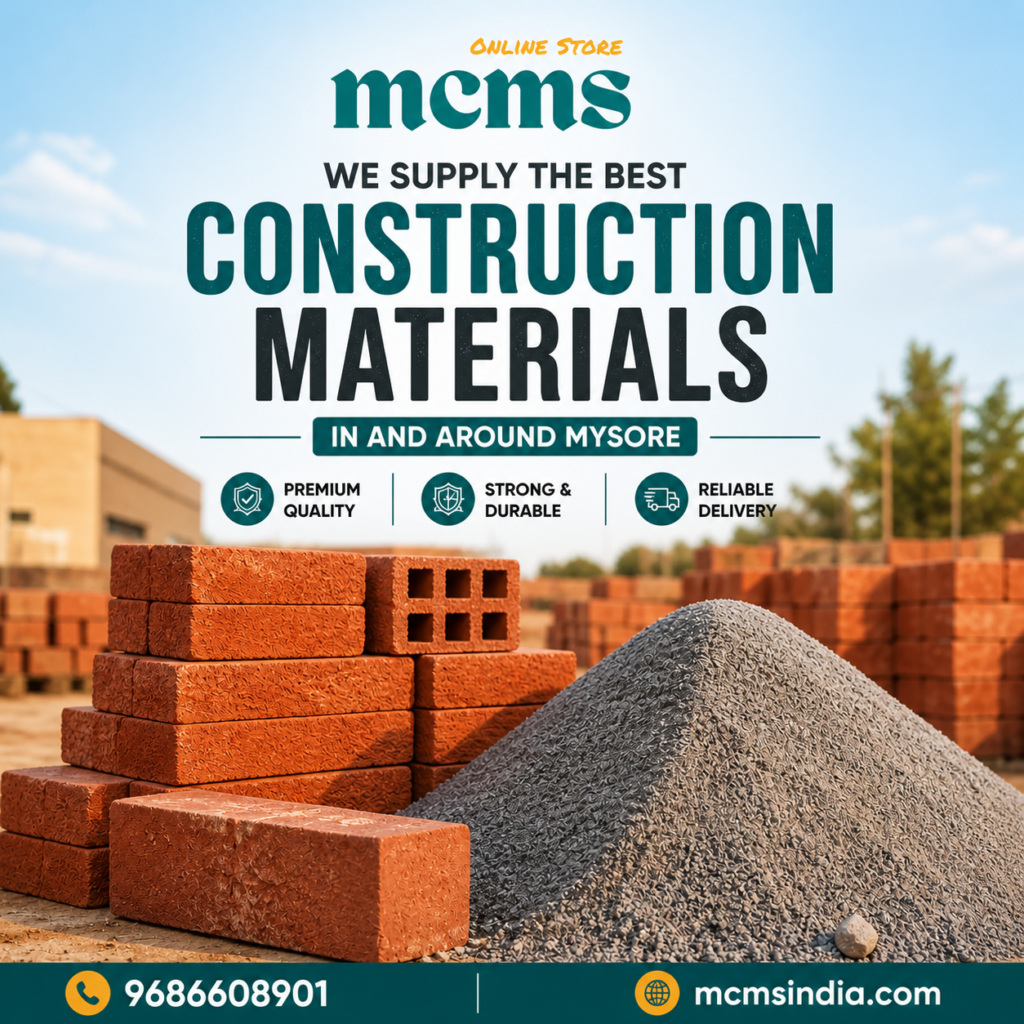
Our goal is to provide a convenient source for construction materials in Mysore, helping customers arrange materials throughout the different stages of construction.
Depending on your project requirements, construction materials can include:
- Aggregates
- Jelly
- M-Sand
- Cement
- Bricks
- Blocks
- Steel
- Construction sand
- Plumbing materials
- Electrical materials
- Flooring materials
- Other building and finishing materials
Instead of coordinating every material separately, customers can discuss their overall construction requirements and plan procurement according to the project stage.
[Internal Link: Construction Materials in Mysore → /construction-materials-in-mysore/]
[Internal Link: Building Materials Supplier in Mysore → /building-materials-supplier-mysore/]
[Internal Link: M-Sand in Mysore → /m-sand-in-mysore/]
Aggregates Supply Across Mysore
We supply construction aggregates for projects across Mysore and surrounding areas, subject to delivery location and material availability.
Our customers may include:
- Individual homeowners
- Civil contractors
- Builders
- Engineers
- Architects
- Developers
- Commercial property owners
- Industrial projects
- Renovation contractors
- Small construction teams
Whether you need a smaller quantity for residential construction or bulk quantities for a larger project, you can contact us to discuss your requirements.
When ordering, provide details such as:
Material required: 20 mm aggregate, 40 mm aggregate, M-Sand, etc.
Quantity required: Mention the estimated quantity.
Delivery location: Provide the construction site location in Mysore.
Application: Foundation, RCC, road, paver, filling or another purpose.
This information helps the supplier understand your requirement and arrange the appropriate material.
Frequently Asked Questions About Aggregates
What are aggregates used for in building construction?
Aggregates are used in concrete, foundations, RCC, roads, driveways, flooring, drainage, paver bases, filling and many other construction activities.
Which aggregate size is commonly used for RCC?
20 mm aggregate is commonly used in many concrete applications, but the correct size depends on the structural design, reinforcement arrangement, concrete mix and engineer’s specification.
Do you supply 20 mm aggregate in Mysore?
Yes, we supply different aggregate sizes for construction projects in Mysore, subject to current availability and project requirements.
Do you supply 40 mm aggregates?
Yes. 40 mm aggregates can be supplied for applications where this size is appropriate, including certain civil and mass-concrete works.
Do you supply M-Sand along with aggregates?
Yes, we supply construction materials including aggregates and fine aggregate materials such as M-Sand, depending on the project requirement and availability.
Can aggregates be used for foundation work?
Aggregates are commonly required in foundation-related concrete and civil works. However, the exact type and size should be selected according to the foundation design and engineer’s specification.
How do I order aggregates in Mysore?
You can contact us with the aggregate type, approximate quantity, construction site location and intended application. We can then discuss the available material and delivery requirements.
Can you supply other construction materials?
Yes. We supply a wide range of construction materials from foundation to finishing stages, allowing customers to coordinate multiple material requirements through one supplier.
Frequently Needed Aggregate Sizes at a Glance
| Aggregate Type | Common Application |
|---|---|
| 6 mm | Smaller concrete and specific civil applications |
| 10 mm | Concrete, precast and selected construction work |
| 12/12.5 mm | Concrete and construction applications where specified |
| 20 mm | RCC and general concrete construction |
| 40 mm | Mass concrete and selected civil works |
| Jelly Stone | Concrete, roads, foundations and general civil work |
| Stone Dust | Filling, leveling and selected civil applications |
| M-Sand | Concrete, masonry, plastering and other applications |
The actual suitability of each material depends on the project specification, grading and intended application.
Order High Quality Aggregates for Building Construction in Mysore
Finding the right construction material supplier can make material procurement easier throughout your project.
If you are searching for High Quality Aggregates for Building Construction in Mysore, we can help you source different types and sizes of aggregates according to your construction requirements.
From 6 mm, 10 mm, 12 mm and 20 mm aggregates to 40 mm aggregates, jelly, crushed stone, stone dust and M-Sand, we can help arrange the materials required for different stages of construction.
We also supply a wide range of construction materials, making it easier for homeowners, contractors and builders to manage procurement from foundation to finish.
Planning a construction project in Mysore? Contact us with your material requirement, quantity and delivery location to discuss your construction material needs.
[Internal Link: Contact Us → /contact-us/]
[Internal Link: Construction Materials → /construction-materials/]
Conclusion
High Quality Aggregates for Building Construction are an important part of a successful construction project. The right aggregate size, grading, cleanliness and quality can contribute to suitable concrete and civil construction performance when selected according to the project requirements.
From foundation and RCC work to roads, driveways, pavers and other civil applications, different types of aggregates serve different purposes.
As a construction materials supplier in Mysore, we supply a wide range of aggregates and other building materials to support projects from the foundation stage through the finishing stage.
If you are looking for aggregates in Mysore, contact us with your required material, quantity and delivery location. We can help you identify the available options for your project and coordinate construction material delivery according to your requirements.