




Best P-Sand for Smooth Wall Plastering Work

Best P-Sand for Smooth Wall Plastering Work in Mysore
Best P-Sand for Smooth Wall Plastering Work is an important consideration when building a new home, renovating an existing property, or finishing commercial construction projects. The quality of sand used for plastering can influence the smoothness of walls, the workability of the mortar, the final appearance of the surface, and the durability of the plaster when the work is properly executed.
If you are planning construction in Mysore, choosing the right sand is just as important as selecting good-quality cement and skilled workers. Whether you are a homeowner, builder, civil contractor, engineer, or mason, understanding the difference between P-Sand, M-Sand, concrete sand, and other construction sands can help you make a better purchasing decision.
As a construction materials supplier in Mysore, we supply materials required for different stages of construction, from foundation work to the final finishing of your building. Our range includes plastering sand, P-Sand, M-Sand, concrete sand, and other essential construction materials, subject to availability and project requirements.
In this guide, we explain how to choose suitable P-Sand for wall plastering, how it compares with other types of sand, what to check before ordering, and how to plan your construction material requirements efficiently. Mysore
Table of Contents
- What Is P-Sand?
- Why Is P-Sand Important for Smooth Wall Plastering?
- Best P-Sand for Smooth Wall Plastering Work in Mysore
- Different Types of Sand Used in Construction
- P-Sand vs M-Sand vs Concrete Sand
- How to Choose Quality Plastering Sand Mysore
- Important Properties of Good P-Sand
- How Sand Quality Affects Wall Finishing Mysore
- Common Wall Plastering Problems and Their Causes
- How to Prepare Walls Before Plastering
- Cement and Sand Proportions for Plastering
- How Much P-Sand Is Required for Plastering?
- Factors Affecting P-Sand Prices in Mysore
- How to Store Sand at a Construction Site
- Why Choose a Construction Materials Supplier in Mysore?
- Construction Materials Available for Your Project
- P-Sand for Residential and Commercial Construction
- Common Mistakes to Avoid When Buying Sand
- Frequently Asked Questions
- Conclusion

1. What Is P-Sand?
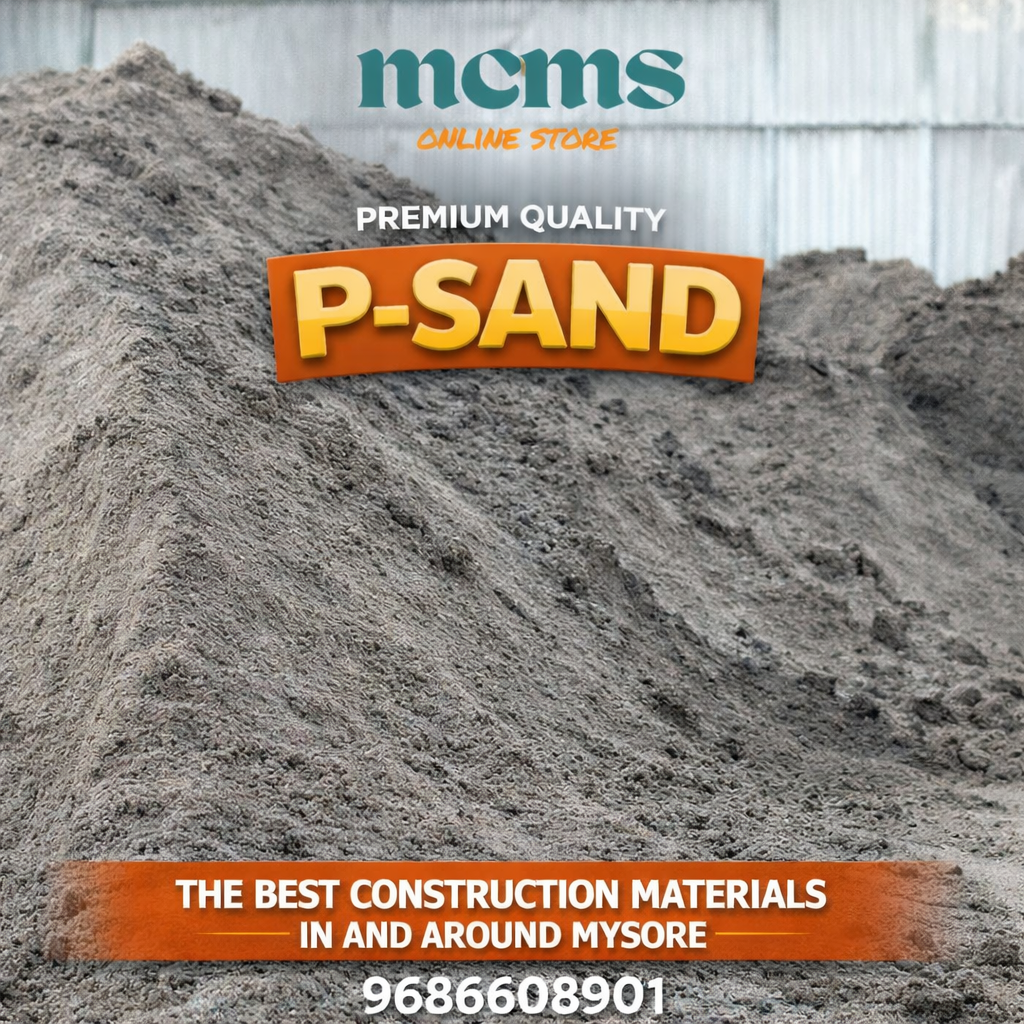
P-Sand stands for plastering sand. It is a type of fine aggregate processed or selected for use in plastering applications. It is used with cement and water to prepare mortar for finishing walls, ceilings, and other surfaces specified for plastering. Mysore
The main purpose of P-Sand is to help produce a workable plaster mortar that can be applied evenly to a prepared surface. When the sand has suitable grading, is clean, and is used with the correct mix and workmanship, it can contribute to a smooth and consistent finish. Mysore
P-Sand is different from ordinary coarse construction sand because plastering generally requires a finer and appropriately graded material. Sand that is too coarse, excessively dusty, contaminated, or poorly graded may make the mortar difficult to apply and finish. Mysore
However, choosing fine sand alone does not guarantee a good result. Sand quality, cement quality, water quantity, wall preparation, plaster thickness, curing, and the skill of the mason all contribute to the final outcome. Mysore
What Is P-Sand Made From?
P-Sand may be produced from suitable crushed rock or obtained from other appropriate sand sources, depending on the supplier and product specifications. Manufactured varieties are processed and screened to achieve a grading suitable for the intended application.
The actual source and characteristics of the sand should be confirmed with the supplier. Not every product marketed as P-Sand has identical particle sizes, cleanliness, or quality.
For projects where material compliance is important, ask whether the supplied sand meets the applicable plastering specification, including IS 1542 where required.
Where Is P-Sand Used?
P-Sand is commonly considered for:
- Internal wall plastering in houses and apartments.
- External wall plastering and rendering, when suitable for the specified system.
- Ceiling plastering where the project specification permits.
- Plastering in offices, shops, and commercial buildings.
- Renovation and repair projects requiring compatible plaster mortar.
- Other finishing applications approved by the project engineer.
The correct sand should always be selected according to the work specification rather than simply choosing the cheapest available material. Mysore
2. Why Is P-Sand Important for Smooth Wall Plastering?
Wall plastering is one of the most visible stages of building construction. A well-finished wall gives the building a neat appearance and provides a suitable base for painting, texture finishes, or other decorative treatments.
Using appropriate P-Sand helps the mason prepare mortar with suitable consistency and workability. Mysore
2.1 Helps Achieve an Even Surface
Suitable grading helps the plaster mortar spread more consistently across the wall. This can make it easier for an experienced mason to level the surface and achieve the required finish.
The final smoothness still depends on the plastering technique, the substrate, the specified thickness, and the finishing method.
2.2 Supports Good Mortar Workability
Mortar should be workable enough to spread and level without becoming excessively stiff or difficult to handle.
Sand with suitable particle distribution can help achieve a consistent mix when combined with the correct cement and water proportions.
Excessively fine material or a high proportion of unwanted dust can increase water demand and may affect the behaviour of the mortar.
2.3 Helps Produce a Consistent Finish
When the sand supply is reasonably uniform from one delivery to another, the construction team can maintain more consistent mixing and finishing practices.
Large variations in grading, moisture, or contamination can make it difficult to reproduce the same mortar consistency across different rooms or floors. IN Mysore

2.4 Supports Proper Plaster Performance
A suitable plaster mix, correctly applied and cured, can provide a durable finishing layer.
The quality of the sand contributes to the performance of the mortar, but no sand type alone can prevent cracks, peeling, or debonding. These problems can also result from poor surface preparation, excessive water, unsuitable thickness, rapid drying, or inadequate curing.
2.5 Provides a Suitable Base for Painting
Paint generally looks better on a properly prepared and adequately cured plaster surface.Mysore
P-Sand helps the plastering process when its grading and cleanliness are appropriate. Before painting, the wall must also be allowed to dry and prepared according to the paint manufacturer’s instructions.Mysore
3. Best P-Sand for Smooth Wall Plastering Work in Mysore
When searching for the best P-Sand for smooth wall plastering work in Mysore, homeowners and contractors should look beyond the product name or advertised price.Mysore
The right choice is plastering sand that matches the project’s specifications, has suitable grading, is reasonably clean, and comes from a supplier who can explain the material’s intended use.Mysore
3.1 Check the Sand’s Intended Application
First, confirm that the material is specifically suitable for plastering.
P-Sand is intended for plastering applications, while concrete sand is selected for concrete production. These materials should not automatically be treated as interchangeable.Mysore
If your contractor has specified a particular sand grading or standard, share that requirement with the supplier before ordering.
3.2 Look for Appropriate Particle Grading
The sand should contain a suitable distribution of particle sizes for the intended plastering work.
Very coarse particles can make fine finishing more difficult. An excessive proportion of very fine particles can increase water demand and affect mortar behaviour.
The correct grading should be established using the applicable product specification or project requirements rather than appearance alone.
3.3 Avoid Unwanted Contamination
Sand should be free from harmful levels of clay, organic matter, rubbish, and other substances that could affect the mortar.
Material contaminated during transport or storage may also create problems, even if it was originally suitable.
Ask your supplier how the sand is sourced, processed, and stored.
3.4 Consider Consistency Between Loads
For larger houses, apartment projects, and commercial buildings, you may need several deliveries.
A consistent material supply can make it easier for the site team to maintain the same mixing and finishing practices. Where necessary, request test documentation or have representative samples checked.
3.5 Confirm Delivery and Quantity
Before placing an order, discuss the required quantity, delivery location, unloading arrangements, and the expected delivery schedule.
For construction projects in Mysore, these details can help reduce delays and avoid unnecessary material shortages.
3.6 Choose a Supplier Who Understands Construction Requirements
A good construction materials supplier should understand that foundation work, concrete production, masonry, and plastering require different materials.
We supply construction materials in Mysore for different stages of building work, including P-Sand, M-Sand, concrete sand, and other materials based on availability and project requirements.
4. Different Types of Sand Used in Construction
Sand is used in several construction applications, but the requirements differ depending on the work.
Understanding the main types helps builders and homeowners order the right material and avoid using a product that is unsuitable for the intended application.
4.1 P-Sand or Plastering Sand
P-Sand is used for preparing plaster mortar for suitable wall and ceiling finishing applications.
Its grading should be appropriate for the plastering specification. Cleanliness, consistency, and compatibility with the chosen mortar system are also important.
Common applications include:
- Internal plastering.
- External plastering where the specified material is suitable.
- Ceiling plastering where permitted.
- General wall-finishing work.
For a smooth wall finish, discuss plastering sand requirements with your mason or engineer before purchasing.
4.2 M-Sand or Manufactured Sand
M-Sand is manufactured sand produced by processing suitable rock or stone.
It is widely used as a fine aggregate in construction, including concrete and masonry applications when it complies with the relevant specifications.
The term M-Sand describes a manufactured material, not one universal grading. Different products may be processed for different applications.
Some manufactured sands are suitable for plastering when they meet the required plastering specification. However, concrete-grade M-Sand should not automatically be used for plastering without checking its grading and suitability.
M-Sand is commonly selected for:
- Concrete production when compliant with the mix specification.
- Masonry mortar when suitable for the application.
- Other approved construction uses.
4.3 Concrete Sand
Concrete sand is sand selected for concrete production. Its grading and quality must match the concrete specification and mix design.
Concrete performance depends on several ingredients, including cement, fine aggregate, coarse aggregate, water, and any specified admixtures.
Concrete sand should not automatically be substituted for plastering sand. A material suitable for concrete may have a grading that is not ideal for smooth wall finishing.
Before ordering, tell the supplier whether the sand is required for an RCC slab, beam, column, footing, or another concrete application.
4.4 River Sand
River sand is naturally occurring sand obtained from river deposits, subject to applicable sourcing and environmental regulations.
Its properties vary by source and processing. It may be used in particular construction applications when it meets the relevant specifications.
Natural origin alone does not guarantee quality. River sand must be checked for grading, cleanliness, and suitability for the intended work.
Buyers should also ensure that the source and supply comply with applicable regulations.
4.5 Masonry Sand
Masonry sand is used in mortar for brickwork, blockwork, and other masonry applications.
The required grading depends on the mortar specification and the type of masonry.
Although masonry sand and plastering sand may appear similar, they should not automatically be substituted for one another. Ask the contractor or engineer to specify the appropriate material.
4.6 Fine Aggregate
Fine aggregate is a broader technical term for the fine portion of aggregate used in concrete and mortar.
P-Sand, suitable M-Sand, and other approved sand materials may fall within the broad category of fine aggregates, depending on their characteristics and application.
However, fine aggregate is not one single product with a universal grading. Its suitability depends on the applicable standard and project requirements.
4.7 Coarse Sand
Coarser sand may be used in certain masonry or construction applications where its grading is appropriate.
It is generally less suitable for producing a fine plaster finish if the particles are too large for the specified application.
Always confirm the intended use before ordering coarse sand.
4.8 Other Construction Aggregates
Construction projects also require materials other than sand, such as coarse aggregates, crushed stone, and graded stone products.Mysore
These materials are used for different purposes, including concrete, foundations, road-related work, and other specified applications.Mysore
A supplier offering multiple construction materials can help contractors coordinate material requirements for different work stages.Mysore
5. P-Sand vs M-Sand vs Concrete Sand
These names often create confusion for homeowners who are purchasing construction materials for the first time.
The most important difference is the intended application and whether the material meets the appropriate specification.Mysore
| Feature | P-Sand | M-Sand | Concrete Sand |
|---|---|---|---|
| Main purpose | Plastering | Manufactured fine aggregate for specified uses | Concrete production |
| Production or source | Depends on the product | Manufactured from processed rock or stone | Depends on the approved source and processing |
| Grading requirement | Suitable for plastering | Depends on the particular grade | Suitable for the specified concrete mix |
| Wall plastering | Common intended use | Only if the grade is suitable and approved | Only if specifically suitable for the plastering specification |
| Concrete work | Not the default choice | Commonly used when compliant | Common intended use |
| Key check before purchase | Plastering suitability | Intended grade and compliance | Concrete specification and mix requirements |
Which Sand Should You Buy?
For wall plastering, begin with P-Sand that meets the required plastering specification.Mysore
For concrete work, select concrete sand or an appropriate grade of M-Sand that complies with the project’s requirements.
For masonry, use sand specified for the mortar and masonry application.Mysore
If you are unsure, provide your supplier with the intended use and ask for the recommended grade. Your engineer or contractor should approve the final selection where the project requires technical approval.Mysore
6. How to Choose Quality Plastering Sand
Selecting plastering sand should be a practical process rather than a decision based only on price.
Use the following checks before placing your order.Mysore
6.1 Confirm the Product Name and Grade
Ask whether the product is plastering sand, concrete-grade M-Sand, masonry sand, or another material.Mysore
Do not rely only on a general label such as fine sand.Mysore
6.2 Ask About the Applicable Standard
For plastering sand in India, IS 1542 is the relevant Indian Standard titled Sand for Plaster — Specification.Mysore
You can review the standard’s listing on the official Bureau of Indian Standards website:
Read the BIS standard details for IS 1542
Check the current applicable requirements and obtain relevant test documents where required.Mysore
6.3 Check Cleanliness
The sand should not contain obvious rubbish, roots, excessive clay lumps, or other unwanted material.Mysore
Visual inspection is useful, but it cannot establish full compliance. Where the project requires it, laboratory testing should be used to verify material properties.Mysore
6.4 Consider Moisture and Storage
Sand moisture can affect handling and the amount of water required in a mix.Mysore
Sand should be stored on a suitable, clean surface where it is protected from contamination. If the sand is wet, the site team may need to account for its moisture when preparing the mortar.Mysore
6.5 Ask About Supply Consistency
For large projects, discuss how repeated loads will be sourced and whether the material characteristics can be maintained.
Where quality requirements are strict, arrange appropriate sampling and testing.
6.6 Compare the Complete Delivered Cost
The lowest quoted price may not represent the lowest overall project cost.Mysore
Consider the delivered quantity, transport charges, unloading arrangements, material quality, and the risk of delays.Mysore
Request a clear quotation so that you can compare suppliers fairly.Mysore
7. Important Properties of Good P-Sand
Several material properties influence the performance of plastering sand.Mysore
7.1 Suitable Grading
Grading refers to the distribution of particle sizes in the sand.Mysore
A suitable grading helps the mortar achieve the required consistency and finish. It should conform to the applicable standard or project specification.Mysore
7.2 Appropriate Particle Shape
Particle shape can influence workability and the way particles pack together.
Manufactured sand may have angular particles because it is produced by crushing rock. Whether a particular product performs well depends on its grading, particle characteristics, fines content, and mix design.
It is not accurate to assume that every manufactured sand has identical performance.
7.3 Controlled Fine Material
Very fine particles may affect the mortar’s water demand and consistency.
The amount and nature of fine material should meet the applicable requirements. The presence of some fine particles is not automatically a defect, but excessive or unsuitable fines can be a problem.
7.4 Freedom From Harmful Impurities
Sand should not contain harmful quantities of substances that can interfere with cement hydration, bonding, durability, or appearance.
The acceptable limits depend on the applicable specification.
7.5 Consistent Quality
Consistent grading and cleanliness make it easier for site workers to reproduce the required mortar mix.
A change in sand source or quality may require the mix and water content to be reassessed.
8. How Sand Quality Affects Wall Finishing
A wall’s final appearance is the result of several factors working together.
Sand is one important factor, but plastering quality also depends on workmanship and site conditions.
8.1 Surface Smoothness
Appropriately graded sand makes it easier to spread and finish the plaster to the required texture.
A very coarse material may make the final surface difficult to finish. The mason must still use the correct tools and technique.
8.2 Cracking Risk
Cracks can occur for many reasons, including excessive water, unsuitable mortar proportions, shrinkage, rapid drying, movement in the substrate, excessive thickness, and inadequate curing.
Using suitable sand helps the mortar perform as intended, but it does not eliminate every cause of cracking.
8.3 Bond With the Wall
Good bonding requires a properly prepared substrate and a suitable plaster mix.
Dust, loose particles, incompatible coatings, or an excessively dry or unsuitable surface may affect adhesion.
Follow the construction specification for cleaning, surface preparation, and any required treatment.
8.4 Water Demand
The particle grading and fines content of sand influence how much water the mortar needs to reach a workable consistency.
Adding too much water to make mortar easier to spread may negatively affect the hardened plaster.
The site team should follow the approved mix proportions and avoid adjusting water carelessly.
8.5 Painting and Decorative Finishes
Plaster should be sufficiently cured and dry before painting or applying other finishes.
The finishing system may also require putty, primer, or surface preparation according to the manufacturer’s instructions.
Good plastering sand contributes to a suitable base, but it does not replace these finishing steps.
9. Common Wall Plastering Problems and Their Causes
Understanding common defects helps homeowners communicate more effectively with their contractor.
9.1 Hairline Cracks
Hairline cracks may be associated with shrinkage, rapid moisture loss, unsuitable mortar proportions, substrate movement, or other factors.
The cause should be identified before selecting a repair method.
9.2 Uneven Walls
Uneven surfaces may result from poor levelling, inadequate reference points, inconsistent plaster thickness, or insufficient workmanship.
Sand grading can influence workability, but material selection alone cannot correct poor application.
9.3 Loose or Debonded Plaster
Plaster may debond when the substrate is poorly prepared, the mortar is unsuitable, application is incorrect, or curing and site conditions are inadequate.
A qualified professional should assess significant areas of loose plaster before repairs begin.
9.4 Excessively Rough Finishing
A rough surface may result from unsuitable sand grading, coarse particles, poor finishing technique, or an intentional texture.
If a smooth finish is required, discuss the specification with the mason before work starts.
9.5 Powdery Surface
A weak or powdery surface can have several causes, including excessive water, poor curing, unsuitable materials, or incorrect mortar preparation.
The problem should be diagnosed rather than automatically blamed on the sand.
9.6 Colour Variations
Variations in materials, moisture, curing, and application conditions may contribute to differences in the finished surface.
Maintaining consistent materials and workmanship can help reduce unwanted variations.
10. How to Prepare Walls Before Plastering
Even the best plastering sand cannot compensate for an inadequately prepared wall.
Proper preparation helps create the conditions needed for the plaster to bond and perform as intended.
Step 1: Inspect the Wall
Check whether the masonry is complete, stable, and ready for plastering.
Identify loose mortar, damaged masonry, service openings, and areas requiring repair.
Step 2: Remove Dust and Loose Material
Clean the surface to remove dust and loose particles that may interfere with bonding.
Follow the project specification for preparing the particular wall material.
Step 3: Address Surface Irregularities
Large gaps, damaged joints, and significant irregularities may require correction before plastering.
The appropriate repair method depends on the substrate and the specified plaster system.
Step 4: Manage Surface Moisture
Some masonry surfaces may need controlled dampening before plaster application, depending on their absorbency and the plaster specification.
Avoid leaving standing water on the wall. Follow the method approved by the contractor or engineer.
Step 5: Check the Mortar Mix
Confirm that the sand, cement, and water are suitable for the application.
Use the specified proportions and ensure that the materials are mixed consistently.
Step 6: Apply and Level the Plaster
The mason should apply the mortar using the specified method and thickness.
Appropriate levelling and finishing tools help achieve the required surface.
Step 7: Cure the Plaster Correctly
Follow the curing requirements for the specified plaster system and site conditions.
Curing helps maintain moisture for cement hydration. The duration and method should be determined by the project specification and professional guidance.
11. Cement and Sand Proportions for Plastering
The correct cement-to-sand ratio depends on the plastering application, required performance, substrate, exposure conditions, and project specification.
Ratios such as 1:4 or 1:6 are commonly discussed in construction practice, where the first number represents cement and the second represents sand by volume. These ratios are examples, not universal instructions for every wall.
For example, a specified 1:4 mix means one measured volume of cement for every four measured volumes of sand. The actual mix to use should be approved for the project.
Why Should You Avoid Guessing the Ratio?
Using too much cement can increase cost and may contribute to shrinkage-related problems in some conditions.
Using too little cement can produce mortar that does not meet the required performance.
Excess water can also affect strength, shrinkage, and the final surface.
For this reason, homeowners should ask their contractor to follow the approved specification instead of choosing a ratio solely to save money.
Does P-Sand Change the Required Ratio?
Sand grading and moisture can affect workability and water demand. A change in material may therefore require the site team to review the mix.
However, there is no single adjustment that applies to every P-Sand product.
The correct approach is to use sand that meets the required specification and follow the approved mix proportions.
12. How Much P-Sand Is Required for Plastering?
Estimating the quantity before ordering helps avoid unnecessary deliveries and delays.
The amount depends on the wall area, plaster thickness, specified mortar proportions, openings, wastage, and the method used to estimate material quantities.
Step 1: Calculate the Wall Area
For a rectangular wall:
Wall area = wall length × wall height.
For multiple walls, calculate each wall separately and add the results. Subtract door and window openings where appropriate.
Step 2: Calculate the Wet Plaster Volume
Multiply the total plastering area by the specified plaster thickness.
For example, if the total wall area is 100 square metres and the specified thickness is 12 millimetres:
- Area: 100 m²
- Thickness: 0.012 m
- Wet plaster volume: 1.2 m³
This is an illustrative example, not a recommended plaster thickness for every project.
Step 3: Estimate the Dry Material Volume
Dry sand and cement generally occupy more combined volume than the final wet mortar volume because dry ingredients contain voids and the mix changes volume when combined.
The appropriate conversion factor should be selected according to the estimating method or project practice. Do not assume that the wet volume is equal to the total loose dry-material volume.
Step 4: Calculate the Sand Share
Once the dry-material volume and approved mix ratio are known, estimate the sand quantity according to the ratio.
For a 1:4 cement-to-sand mix, the nominal sand share is four out of five total parts of the measured dry ingredients. This is only an initial calculation; the appropriate dry-volume conversion and site conditions must also be considered.
Step 5: Account for Site Conditions
Allow for reasonable wastage, surface irregularities, handling losses, and the actual condition of the masonry.
Avoid ordering an arbitrary extra quantity without considering storage and the possibility of material loss.
Need Help Estimating Your Sand Requirement?
Share the approximate wall area, plaster thickness, and mix ratio specified by your contractor with your construction materials supplier. This information helps prepare a more useful quantity estimate.
13. Factors Affecting P-Sand Prices in Mysore
P-Sand prices can vary according to the product, source, quantity, delivery location, and market conditions.
Rather than relying on a single advertised rate, request a current quotation for your specific site.
13.1 Material Quality
Different products may have different grading, processing, cleanliness, and quality-control requirements.
A price comparison is meaningful only when the materials are suitable for the same intended application.
13.2 Order Quantity
The quantity required for a small renovation may differ significantly from the quantity needed for an apartment building or commercial project.
Ask whether the quotation covers the required quantity and whether multiple deliveries can be arranged.
13.3 Transportation Distance
The distance between the source, supplier’s loading point, and construction site can influence the delivered cost.
Access restrictions and unloading conditions may also affect transport arrangements.
13.4 Delivery Scheduling
Construction projects often depend on materials arriving at the correct stage.
Coordinate delivery with the mason, site supervisor, and available storage space to avoid unnecessary waiting or double handling.
13.5 Market Conditions
Availability, transportation costs, fuel prices, and seasonal conditions can change the final quotation.
For this reason, confirm the current delivered price before making a purchase decision.
13.6 How to Request a Clear Quotation
When contacting a supplier, specify:
- The type of sand required.
- The quantity required.
- Your construction site location in or around Mysore.
- The intended application.
- The preferred delivery date.
- Any applicable material specifications.
A clear quotation makes it easier to compare suppliers and plan the construction budget.
14. How to Store Sand at a Construction Site
Proper storage helps maintain the quality of delivered construction sand.
Even suitable sand can become contaminated if it is dumped on an unsuitable surface or mixed with other materials.
Use a Clean Storage Area
Store sand on a clean, firm, suitably drained surface.
Avoid areas where soil, waste, mud, or runoff can mix with the material.
Separate Different Sand Grades
Keep P-Sand, M-Sand, concrete sand, and other aggregates in separate stockpiles.
Clear separation reduces the chance of workers using the wrong material for a particular task.
Protect Against Contamination
Keep rubbish, organic waste, cement bags, and other unwanted materials away from the stockpile.
Use suitable barriers or covers when necessary.
Consider Moisture
Rain can change the moisture content of sand and affect batching.
The site team should account for moisture when measuring materials and adjusting the mixing water in accordance with the approved procedure.
Plan Deliveries Around Consumption
Ordering too early may create storage problems, while ordering too late may delay construction.
Coordinate material deliveries with the construction schedule and the site’s available storage capacity.
15. Why Choose a Construction Materials Supplier in Mysore?
Building a house requires more than buying sand. The project may also need cement, aggregates, steel, blocks, bricks, and materials for finishing work.
Working with a supplier who understands the different construction stages can make material planning more convenient.
15.1 Materials for Different Construction Stages
Foundation work, concrete production, masonry, plastering, and finishing require different products.
We supply construction materials for projects in Mysore, with products selected according to the intended application and availability.
15.2 Support for Homeowners and Contractors
Individual homeowners may need guidance on the difference between plastering sand and concrete sand.
Contractors may need to coordinate larger quantities and repeated deliveries.
Clear communication about material specifications and quantities helps both groups plan their work.
15.3 Convenient Material Coordination
When several materials are required at different stages, coordinating orders can simplify site planning.
Confirm product availability, transport arrangements, and delivery dates with the supplier before scheduling work.
15.4 Focus on the Requirements of Your Project
Every construction project has different material requirements.
A small residential renovation may need a limited quantity of P-Sand, while a larger project may require separate supplies of plastering sand, M-Sand, concrete sand, and aggregates.
Explaining your project requirements helps the supplier provide a more relevant quotation.
16. Construction Materials Available for Your Project
As a construction materials supplier in Mysore, we cater to the material needs of different construction stages, from foundation to finishing.
The materials listed below are examples of products to ask about. Confirm current availability, specifications, and delivery arrangements before placing your order.
P-Sand for Wall Plastering
P-Sand is intended for suitable plastering applications.
It is an important material for internal and external wall finishing when the product meets the relevant specification.
M-Sand for Approved Construction Applications
M-Sand is manufactured from processed stone.
Different grades may be used for concrete, masonry, and other applications where the material meets the applicable requirements.
Concrete Sand
Concrete sand is selected for concrete production in accordance with the mix and aggregate specifications.
Tell your supplier whether the material is needed for footings, columns, beams, slabs, or another concrete element.
Other Sand and Aggregate Requirements
Depending on the project, you may also require masonry sand, natural sand, or other approved aggregates.
The correct selection should be based on the intended use rather than the product name alone.
Cement and Other Building Materials
Beyond sand, construction projects may require cement, steel, blocks, bricks, and other materials.
Discuss your full requirement so that the supply schedule can be coordinated with the construction stages.
Plan Your Construction Material Order
Before placing an order, prepare a list of the materials required, the approximate quantities, and the expected delivery dates.
For a more accurate quotation, share your project location and intended applications with our team.
17. P-Sand for Residential and Commercial Construction
P-Sand can be used in various plastering projects when it meets the specified requirements.
The quantity, delivery schedule, and material controls may differ depending on the type of building.
17.1 Individual Houses
Home construction commonly includes internal and external plastering after the masonry and associated preparation work are complete.
The homeowner should coordinate the sand specification with the contractor and arrange delivery according to the work schedule.
17.2 Apartments
Apartment projects may require substantial quantities of plastering sand over several floors.
Separate storage areas, delivery planning, and consistent material specifications can help the site team manage the work.
17.3 Commercial Buildings
Offices, shops, and other commercial properties may have specific requirements for the wall finish and the timing of subsequent painting or decorative work.
The selected sand should comply with the plaster specification and any project-specific quality requirements.
17.4 Renovation Projects
Renovation work may involve patching, repairing damaged plaster, or replastering entire walls.
The correct repair method depends on the condition of the existing surface and the compatibility of the new material.
For repairs involving extensive debonding, persistent dampness, or recurring cracks, seek professional assessment before starting the work.
18. Common Mistakes to Avoid When Buying Sand
A few simple checks can help avoid unnecessary costs and material problems.
Mistake 1: Buying Only on the Basis of Price
Cheap material may not be suitable for the intended application.
Compare the delivered cost of products that meet the same specification.
Mistake 2: Confusing P-Sand With Concrete Sand
Both are sand products, but their grading requirements and intended uses can differ.
Always state whether you need sand for plastering, masonry, or concrete.
Mistake 3: Assuming All M-Sand Is the Same
M-Sand products can differ in grading, fines content, processing, and intended application.
Check the grade and suitability before ordering.
Mistake 4: Ignoring Contamination
Soil, organic matter, and other unwanted substances can affect the quality of construction materials.
Inspect deliveries and store them appropriately.
Mistake 5: Ordering Without Calculating Quantity
An inaccurate estimate can lead to shortages, unnecessary transport costs, or excessive leftover material.
Estimate the area and thickness, then confirm the calculation with your contractor.
Mistake 6: Failing to Plan Delivery
Late deliveries can delay the construction team.
Discuss the required delivery dates and site access before confirming the order.
Mistake 7: Expecting Sand Alone to Prevent Cracks
Sand quality matters, but cracking also depends on the substrate, mortar proportions, plaster thickness, curing, and environmental conditions.
Use suitable materials and follow the approved construction method.
19. Frequently Asked Questions
Q1. Which sand is best for smooth wall plastering?
P-Sand that meets the applicable plastering specification is a suitable starting point. Its grading, cleanliness, and consistency should match the project’s requirements. Workmanship and curing are also essential for a good finish.
Q2. Is P-Sand the same as M-Sand?
No. P-Sand refers to sand intended for plastering, while M-Sand refers to manufactured sand. A manufactured sand product may be suitable for plastering if it meets the required specification, but not every M-Sand grade is automatically suitable.
Q3. Can concrete sand be used for wall plastering?
Concrete sand should not automatically be used for plastering. Its grading may differ from the requirements for plaster mortar. Use it for plastering only if its suitability is established under the applicable specification and approved for the project.
Q4. What is the relevant Indian Standard for plastering sand?
IS 1542 is the Indian Standard titled Sand for Plaster — Specification. Check the official Bureau of Indian Standards listing for the applicable requirements and related information.
Q5. Does finer sand always produce a smoother wall?
No. Sand needs suitable grading, not simply the smallest possible particles. Excessively fine material can increase water demand and affect mortar performance. The final finish also depends on the mix, wall preparation, and mason’s technique.
Q6. Can good P-Sand prevent cracks?
Good-quality plastering sand can contribute to suitable mortar performance, but it cannot guarantee crack-free plaster. Cracks may result from shrinkage, movement, excessive water, poor curing, incorrect thickness, or other construction issues.
Q7. How do I estimate the quantity of P-Sand needed?
Calculate the total wall area, multiply it by the specified plaster thickness, and estimate the required dry ingredients using the approved mortar ratio and suitable dry-volume conversion. Include reasonable allowances for site conditions and confirm the calculation with your contractor.
Q8. What affects the price of P-Sand in Mysore?
Price can depend on material grade, source, order quantity, transportation, delivery distance, availability, and unloading arrangements. Request a current quotation for your specific site.
Q9. Can I order P-Sand and M-Sand from the same supplier?
A construction materials supplier may offer both products, subject to availability. Confirm that each product meets the specification for its intended application before ordering.
Q10. Is river sand always better than manufactured sand?
Not necessarily. Performance depends on the material’s quality, grading, cleanliness, suitability, and the requirements of the application. Natural and manufactured sand should both be evaluated against the relevant specification.
Q11. What other materials are required for house construction?
Depending on the project stage, you may need cement, steel, aggregates, masonry materials, sand, and finishing products. Prepare a material schedule with your contractor to identify the correct products and quantities.
Q12. Where can I buy P-Sand for wall plastering in Mysore?
You can contact our construction materials supply team in Mysore to enquire about P-Sand, M-Sand, concrete sand, and other building materials. Share your site location, quantity, intended application, and delivery requirements to request a suitable quotation.
20. Conclusion
Choosing the Best P-Sand for Smooth Wall Plastering Work starts with understanding the purpose of the material and checking that it meets the required plastering specification.
P-Sand is commonly used for wall plastering, while M-Sand and concrete sand serve different applications depending on their grading and compliance. The correct selection helps the construction team prepare suitable mortar, but a good finish also requires proper surface preparation, correct mixing, skilled application, and appropriate curing.
If you are building or renovating a property in Mysore, plan your material requirements before work begins. Confirm the type of sand, quantity, quality requirements, delivery schedule, and total delivered cost.
We supply construction materials for different stages of building work, from foundation to finishing, including P-Sand, M-Sand, concrete sand, and other materials according to availability and project needs.
Looking for P-Sand or other construction materials in Mysore? Contact us today to discuss your requirements and arrange a quotation for your project.
We will never break your trust like others do