




Aggregates Suppliers Near Mysore for Construction

Aggregates Suppliers Near Mysore for Construction – Best Materials
If you are searching for Aggregates Suppliers Near Mysore for Construction, choosing the right supplier is an important part of planning any building project. Aggregates are used in concrete, foundations, flooring, roads, masonry work, drainage, landscaping and many other construction activities.
At our construction materials supply business in Mysore, we provide a wide range of building materials required from foundation to finish. Along with cement, steel, sand and other construction products, we supply different types and sizes of aggregates for residential, commercial and infrastructure projects.
Whether you are constructing a house, apartment, commercial building, compound wall, road or other civil construction project, the type and size of aggregate you require can vary according to the work.
This guide explains the different types of aggregates commonly used for construction, their applications and what you should consider when purchasing aggregates in and around Mysore.
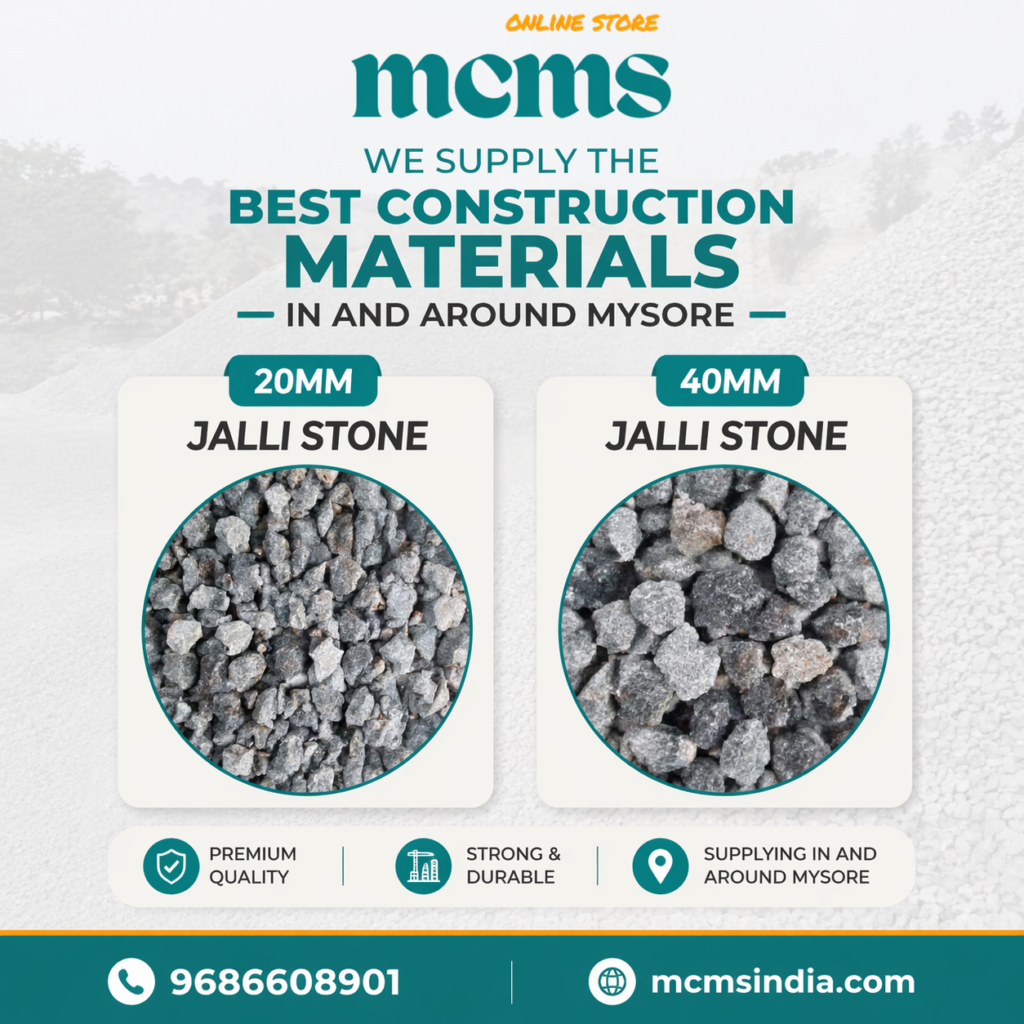
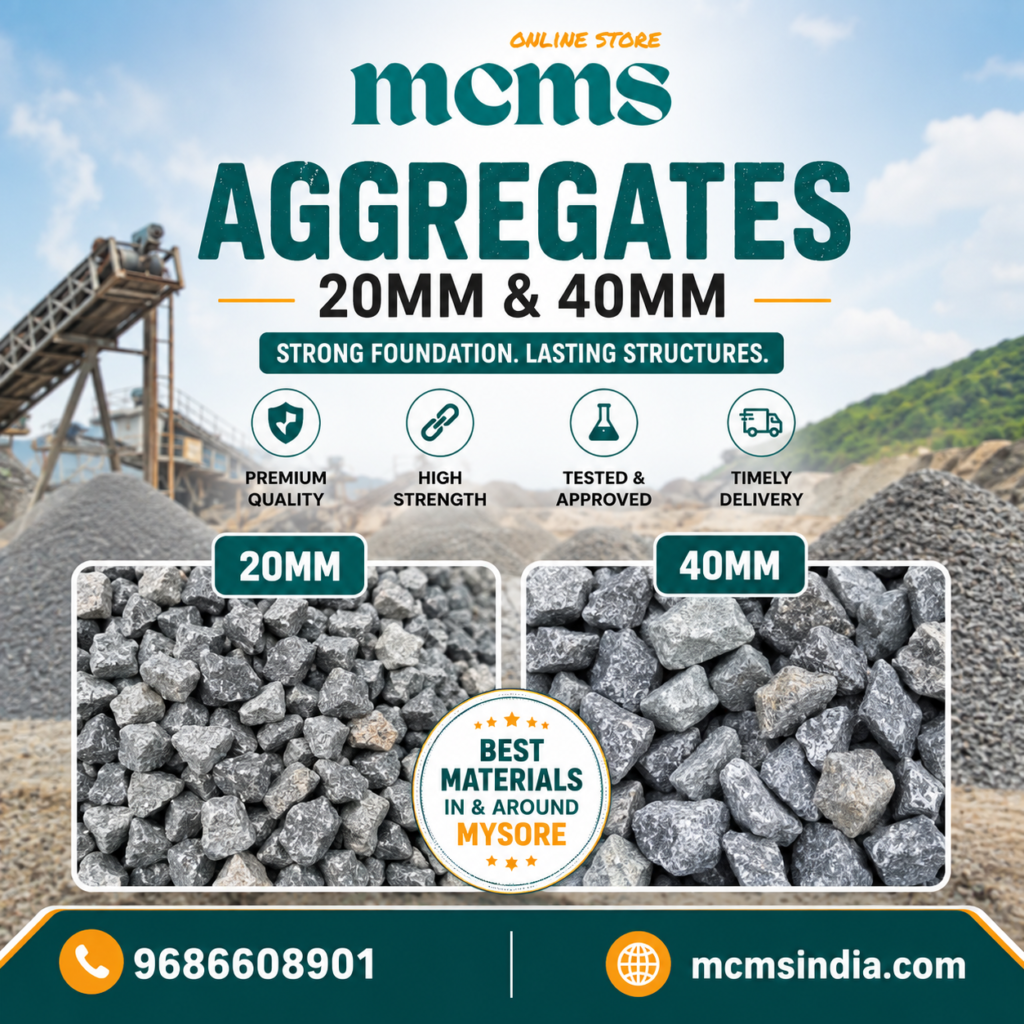
Table of Contents
- What Are Construction Aggregates?
- Why Are Aggregates Important in Construction?
- Types of Aggregates We Supply
- 20mm Aggregate
- 40mm Aggregate
- 6mm Aggregate
- Jelly and Crushed Stone Aggregates
- Coarse Aggregates
- Fine Aggregates and M-Sand
- Aggregates for Concrete
- Aggregates for Foundation Work
- Aggregates for Road and Civil Work
- How to Choose the Right Aggregate
- What to Check Before Buying Aggregates
- Why Choose a Local Aggregate Supplier in Mysore?
- Construction Materials From Foundation to Finish
- Frequently Asked Questions
- Contact an Aggregate Supplier Near Mysore
What Are Construction Aggregates?
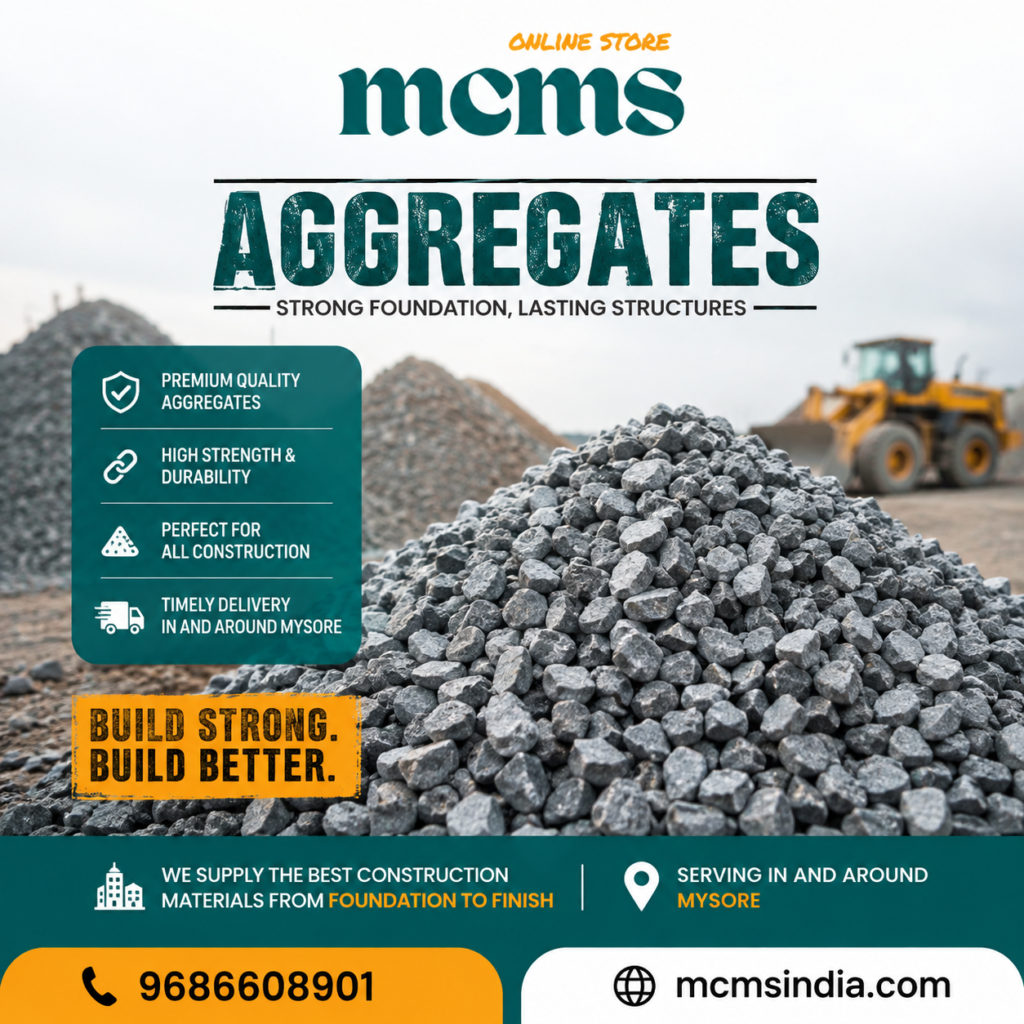
Aggregates are granular construction materials used along with cement, sand, water and other materials to produce concrete and mortar or for various civil engineering applications.
Common aggregates include crushed stone, gravel, crushed gravel, natural sand and manufactured aggregates. The Bureau of Indian Standards identifies aggregates as an important component of concrete and provides specifications for coarse and fine aggregates used in concrete.
Aggregates are generally divided into two broad categories:
- Fine aggregates
- Coarse aggregates
The appropriate material depends on the application, concrete mix, required grading and project specifications.
For example, a contractor may require 20mm aggregate for regular reinforced concrete work, while larger aggregate may be required for particular foundation, road or civil construction applications.
That is why buying the correct aggregate is more important than simply buying the cheapest material available.
Why Are Aggregates Important in Construction?
Aggregates form a major part of many concrete mixes and civil construction works.
They contribute to the volume and structural characteristics of concrete and can influence properties such as workability, strength, durability and water demand.
According to BIS, IS 383:2016 covers requirements for coarse and fine aggregates used in concrete for normal structural purposes, including parameters relating to grading and properties such as crushing, impact, abrasion, soundness and alkali-aggregate reaction.
The right aggregate should therefore be selected according to the intended use.
For a house construction project, different aggregate sizes may be required at different stages. The requirements for a foundation may not be identical to those for a slab, driveway, road base or drainage application.
Types of Aggregates We Supply
As a construction materials supplier in Mysore, we can supply different types and sizes of aggregates depending on project requirements and availability.
Our aggregate range can include:
- 6mm aggregate
- 10mm aggregate
- 12mm aggregate
- 20mm aggregate
- 40mm aggregate
- Jelly
- Crushed stone
- Coarse aggregate
- Fine aggregate
- M-sand
- Stone dust
- Manufactured aggregates
- Other aggregate sizes based on project requirements
The exact size required should be selected according to the application and the project specification.
20mm Aggregate
20mm aggregate is one of the commonly used aggregate sizes in building construction.
It is frequently used in concrete-related applications such as:
- RCC construction
- Columns
- Beams
- Slabs
- Footings
- Foundations
- Concrete floors
- General structural concrete
For many residential construction projects, 20mm aggregate is a commonly requested material.
However, the appropriate aggregate size should always be determined according to the concrete mix design, reinforcement arrangement and project requirements rather than selecting a size simply because it is commonly used.
40mm Aggregate
40mm aggregate consists of larger-sized crushed stone and is used for applications where larger aggregate is suitable.
It can be used in:
- Mass concrete
- Certain foundation applications
- Road and civil works
- PCC applications
- Filling and base-related works
- Other heavy construction applications
The suitability of 40mm aggregate depends on the specific work and design requirements.
For reinforced concrete with closely spaced reinforcement, smaller aggregate may be more appropriate. Therefore, contractors should confirm the required aggregate size before ordering.
6mm Aggregate
6mm aggregate is a smaller aggregate commonly used for selected construction and civil works.
Depending on the project, it can be used for:
- Concrete-related applications
- Flooring work
- Small concrete elements
- Precast work
- Paver-related applications
- Other specialized construction requirements
The exact application depends on the material grading and project specification.
Jelly and Crushed Stone Aggregates
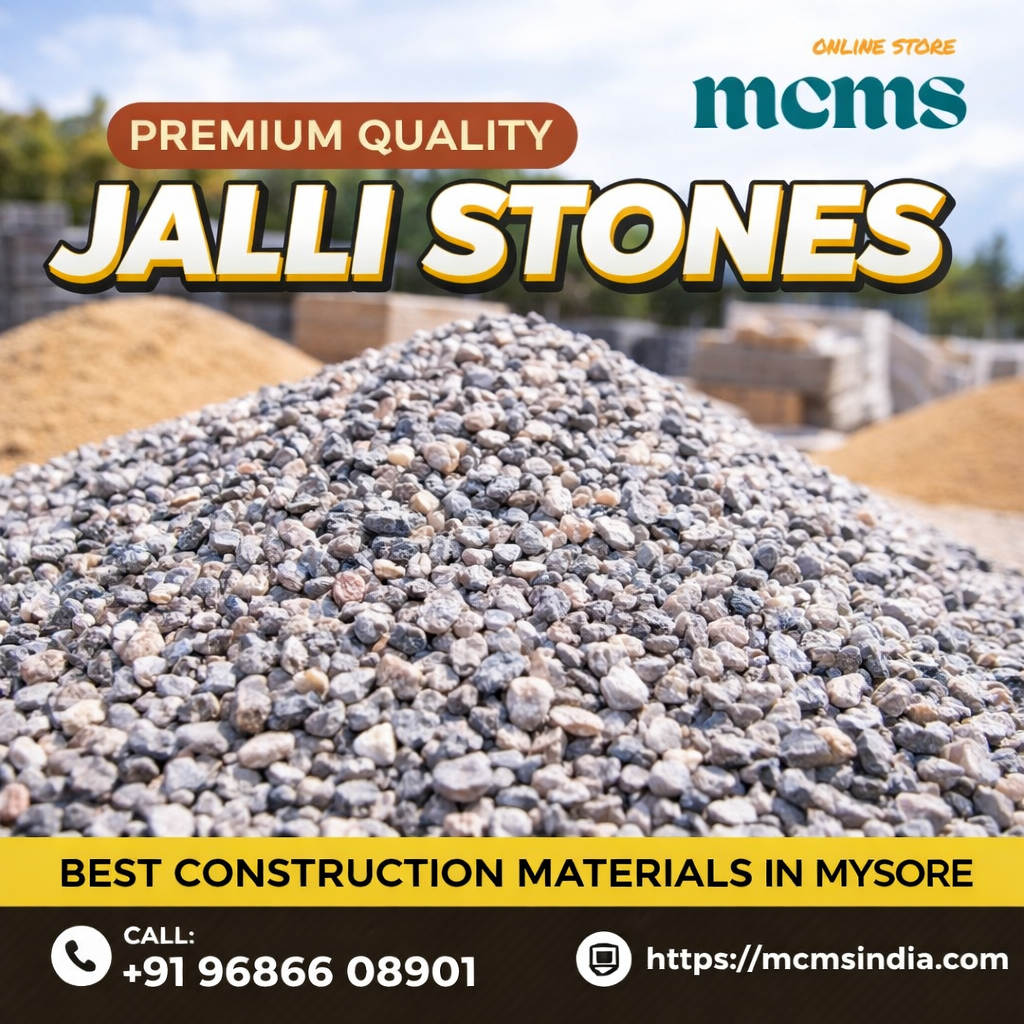
In the local construction industry, aggregate is often commonly referred to as jelly.
Jelly generally refers to crushed stone aggregate used for different construction and civil engineering applications.
Crushed stone is produced by crushing suitable rock into specified sizes. Different sizes can then be used for different purposes.
When ordering jelly or crushed stone, it is useful to clearly communicate:
- Required aggregate size
- Quantity required
- Intended application
- Delivery location
- Required delivery date
- Any project-specific specification
This helps the supplier understand your requirement and arrange the appropriate material.
Coarse Aggregates
Coarse aggregate generally refers to larger aggregate particles retained above the fine aggregate range.
Common construction sizes include 10mm, 12.5mm, 20mm and 40mm, depending on the application and specification.
Coarse aggregates are widely used in concrete and civil works.
Their characteristics can affect the performance of concrete. BIS specifications for aggregates include requirements and testing related to grading, crushing value, impact value, abrasion, soundness and other properties.
For this reason, a professional construction material supplier should understand the intended application before supplying a particular aggregate.
Fine Aggregates and M-Sand
Fine aggregate is generally made up of smaller particles and is used in concrete and mortar.
M-sand, or manufactured sand, is widely used as a construction material in India.
Depending on the application, customers may require different types of fine aggregate or manufactured sand for:
- Concrete
- Block work
- Brickwork
- Plastering
- Mortar
- Flooring
- General building work
BIS documentation classifies fine aggregate separately from coarse aggregate and provides grading requirements for fine aggregates.
If you are ordering sand and aggregates together, it is useful to tell your supplier exactly what construction activity the material is intended for.
Aggregates for Concrete
Concrete is one of the most important applications for aggregates.
A typical concrete mix contains cement, water, fine aggregate and coarse aggregate, along with other materials when specified.
The aggregate should be suitable for the intended concrete application and should meet the relevant project requirements.
For structural concrete, specifications should not be ignored simply because a material looks visually clean or is commonly available.
IS 383:2016 addresses coarse and fine aggregate requirements for concrete, while aggregate testing methods are covered by the relevant Indian Standards, including the IS 2386 series.
This is especially important for projects where concrete performance and durability are critical.
Aggregates for Foundation Work
The foundation is one of the most important stages of any building project.
Depending on the design and construction method, aggregate may be required for:
- PCC
- Footings
- Foundation concrete
- Levelling work
- Concrete beds
- Drainage-related work
- Backfilling or base applications where specified
The exact material and size should be selected according to the structural design and site requirements.
If you are constructing a new house in Mysore, discussing the required material list with your engineer or contractor before ordering can help avoid incorrect quantities or unsuitable materials.
Aggregates for Road and Civil Work
Aggregates are also widely used beyond building construction.
They may be required for:
- Internal roads
- Driveways
- Pathways
- Pavement-related work
- Base and sub-base applications
- Drainage work
- Site development
- Landscaping
- General civil works
Different civil engineering applications require different gradings and material properties.
Therefore, the same aggregate should not automatically be used for every application.
For larger projects, the engineer or project consultant may specify the aggregate grading and required test properties.
How to Choose the Right Aggregate
Choosing an aggregate supplier is not only about finding a nearby seller.
Before ordering, consider the following points.
1. Identify the Construction Application
First, determine where the aggregate will be used.
Are you ordering it for:
- RCC?
- Foundation?
- PCC?
- Flooring?
- Road work?
- Drainage?
- Filling?
- Precast products?
The application helps determine the appropriate material.
2. Confirm the Aggregate Size
Always confirm whether you need 6mm, 10mm, 20mm, 40mm or another specified size.
Do not assume that one size can replace another.
3. Check the Required Quantity
Estimate the quantity required before arranging delivery.
For larger projects, coordinate with your contractor, engineer or site supervisor so that the material order matches the construction schedule.
4. Consider Material Quality
Aggregate quality matters.
For applications covered by Indian Standards, relevant specifications and testing requirements should be considered. IS 383:2016 includes requirements concerning grading and several aggregate properties.
5. Plan Delivery
Construction sites need materials at the right time.
A reliable supplier should be able to discuss delivery requirements, quantity and site location before confirming the order.
What to Check Before Buying Aggregates
Before placing your order, ask the supplier a few simple questions:
What aggregate size is available?
Confirm the exact size rather than relying on a general term such as “jelly.”
Is the material suitable for my application?
Tell the supplier whether it is intended for RCC, foundation, road work or another purpose.
How much material do I need?
Your contractor or engineer can help calculate the requirement.
Can you deliver to my site?
This is particularly important when ordering large quantities.
Is the material supplied according to the required specification?
For specified concrete applications, discuss relevant requirements and testing with your engineer or project team.
Why Choose a Local Aggregate Supplier in Mysore?
Working with a local construction material supplier can make material planning easier.
If your project is in Mysore or nearby areas, a supplier familiar with local construction requirements can help coordinate multiple materials and deliveries.
This becomes particularly useful when you need more than aggregates.
Instead of arranging cement from one supplier, steel from another, sand from another and aggregates from yet another source, you can work with a construction material supplier who can coordinate multiple categories of materials.
That can simplify purchasing and site management.
Construction Materials From Foundation to Finish
Aggregates are only one part of a construction project.
A building project may require dozens of different materials from the foundation stage to the final finishing work.
As a construction materials supplier in Mysore, we supply a wide range of materials for different stages of construction, including materials such as:
- Cement
- Steel
- M-sand
- Aggregates
- Bricks
- Blocks
- Binding materials
- Plumbing materials
- Electrical materials
- Waterproofing products
- Tiles
- Sanitary products
- Construction chemicals
- Finishing materials
- Other building materials
If you are planning a new residential or commercial project, having a single construction material supplier can make procurement and delivery coordination easier.
You can also explore our other services through our [construction materials supply page] and [building materials in Mysore page].
Aggregates Suppliers Near Mysore for Construction Projects
When searching for Aggregates Suppliers Near Mysore for Construction, think beyond the price per load.
A good purchasing decision should consider the aggregate type, size, intended application, quantity, material suitability and delivery requirements.
For example, a contractor constructing a residential building may need 20mm aggregate for RCC work, M-sand for concrete or masonry, and larger aggregate for specific civil works.
A commercial or infrastructure project may have more detailed material specifications and testing requirements.
The best approach is to prepare your material requirement in advance and communicate the exact specification to your supplier.
Aggregates for Residential Construction in Mysore
Residential construction projects often require aggregates at multiple stages.
For a typical house construction project, aggregate may be required for:
- Foundation concrete
- PCC
- Footings
- Columns
- Beams
- Roof slabs
- Flooring
- Compound walls
- Driveways
- External works
The quantity and size will depend on the building design and construction method.
For a new home in Mysore, coordinate with your civil engineer or contractor before finalizing the material order.
Aggregates for Commercial Construction
Commercial buildings can require substantially larger quantities of construction materials.
Depending on the project, aggregates may be needed for structural concrete, flooring, foundations, roads, parking areas, drainage and other civil works.
Large projects may also require consistent supply schedules.
For this reason, commercial customers should discuss:
- Monthly or weekly material requirements
- Required aggregate sizes
- Delivery schedule
- Site access
- Quantity
- Project specifications
- Quality documentation where required
Early planning can help reduce interruptions to the construction schedule.
Local Delivery of Construction Aggregates
Transportation is an important part of buying aggregates because aggregate is a bulk material.
When comparing suppliers, consider the delivered cost rather than looking only at the material price.
Factors such as distance, quantity, vehicle type, loading and unloading requirements can affect the final cost.
If your construction site is in Mysore or the surrounding region, tell the supplier your exact site location and required quantity so the delivery can be planned properly.
Quality Matters More Than Appearance
One common mistake is judging aggregate quality only by appearance.
Two loads may look similar while having different grading or other properties.
For specified construction applications, relevant testing and standards should be considered.
BIS lists several aggregate properties and test methods, including particle size distribution, specific gravity, water absorption, flakiness and elongation, soundness and mechanical properties.
For structural or technically demanding projects, always follow the specifications provided by your engineer or project consultant.
How We Help Construction Customers in Mysore
Our goal is to make construction material procurement easier for customers in Mysore.
Instead of focusing on only one product, we supply construction materials across different stages of a project.
For aggregate requirements, customers can discuss:
- Required aggregate type
- Required size
- Quantity
- Construction application
- Delivery location
- Delivery schedule
- Related construction materials
This approach is particularly helpful for homeowners, contractors, builders, civil engineers and commercial construction teams who need multiple materials for the same project.
Frequently Asked Questions
Which aggregate is commonly used for RCC work?
20mm aggregate is commonly used for many RCC applications, but the appropriate size depends on the structural design, reinforcement arrangement, concrete mix and project specifications.
What is 40mm aggregate used for?
40mm aggregate is a larger aggregate that can be used for suitable mass concrete, foundation-related and civil construction applications. Its suitability should be confirmed for the particular project.
What is the difference between fine and coarse aggregate?
Fine aggregate consists of smaller particles, while coarse aggregate consists of larger particles. Both can play different roles in concrete and construction.
Is M-sand an aggregate?
M-sand is manufactured sand and is generally classified as fine aggregate when used in concrete and related applications. Its grading and suitability should match the intended use.
Can I order aggregates for a house construction project in Mysore?
Yes. You can discuss your required aggregate size, quantity and delivery location with a local construction materials supplier.
How do I know how much aggregate I need?
The required quantity depends on the dimensions of the work, mix design and construction application. For structural work, your engineer or contractor should calculate the required quantity.
Do aggregates need to meet Indian Standards?
For applications governed by Indian Standards, the applicable specification should be followed. IS 383:2016 specifies requirements for coarse and fine aggregates used for concrete.
Can I buy other construction materials along with aggregates?
Yes. A full-service construction materials supplier can help arrange other products such as cement, steel, sand, bricks, blocks, plumbing products, electrical materials and finishing products.
Why Order Aggregates Along With Other Building Materials?
Construction projects rarely require only one material.
If you are building a house, you may simultaneously require cement, steel, aggregates, M-sand, blocks and other products.
Coordinating these materials through one supplier can simplify procurement and delivery planning.
It can also make it easier to communicate your project requirements and schedule deliveries according to different stages of construction.
This is where a full-range construction material supplier in Mysore can be useful.
Planning a Construction Project in Mysore?
If you are starting a new construction project, prepare your material requirements before construction reaches each stage.
For aggregates, keep the following information ready:
Project type: Residential, commercial, industrial or civil work
Material required: 6mm, 10mm, 20mm, 40mm, jelly, M-sand or another specification
Quantity: Estimated requirement for the current construction stage
Location: Exact delivery location
Application: Foundation, RCC, road work, flooring, drainage or another purpose
Delivery requirement: Preferred delivery date and schedule
Providing this information allows your supplier to understand your requirement more accurately.
Contact Aggregates Suppliers Near Mysore for Construction
If you are looking for Aggregates Suppliers Near Mysore for Construction, we can help with your aggregate and broader construction material requirements.
From foundation materials to finishing products, our aim is to provide a convenient source for construction materials in Mysore.
Whether you are a homeowner building your first house, a contractor managing multiple sites, a builder working on a commercial project or a civil construction professional, you can discuss your material requirements with us.
For aggregate enquiries, share your required aggregate type, size, quantity and delivery location.
We can then help you identify the appropriate material for your construction requirement and arrange the supply according to availability and project needs.
Need aggregates for your construction project in Mysore? Contact us today to discuss your requirement.
We will never break your trust like others do